Archives & Engineering Reports
Select a competition season to view its complete certified engineering dossier, CAD blueprints, and flight test data.
ECLifter | Season 2024
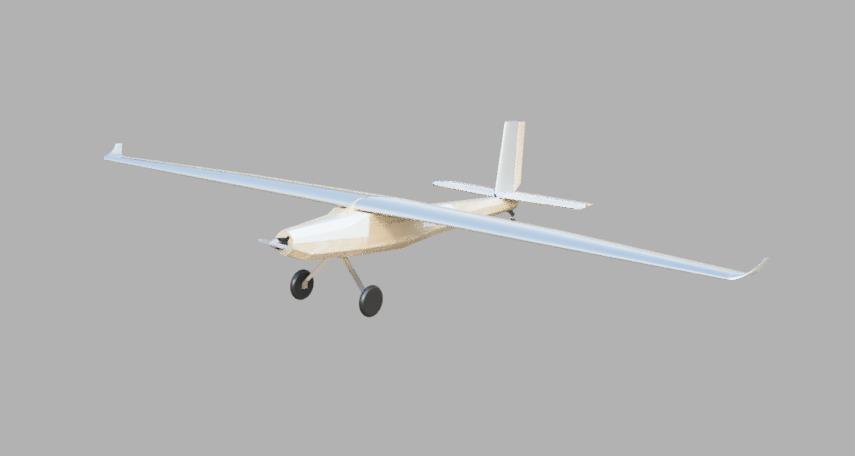
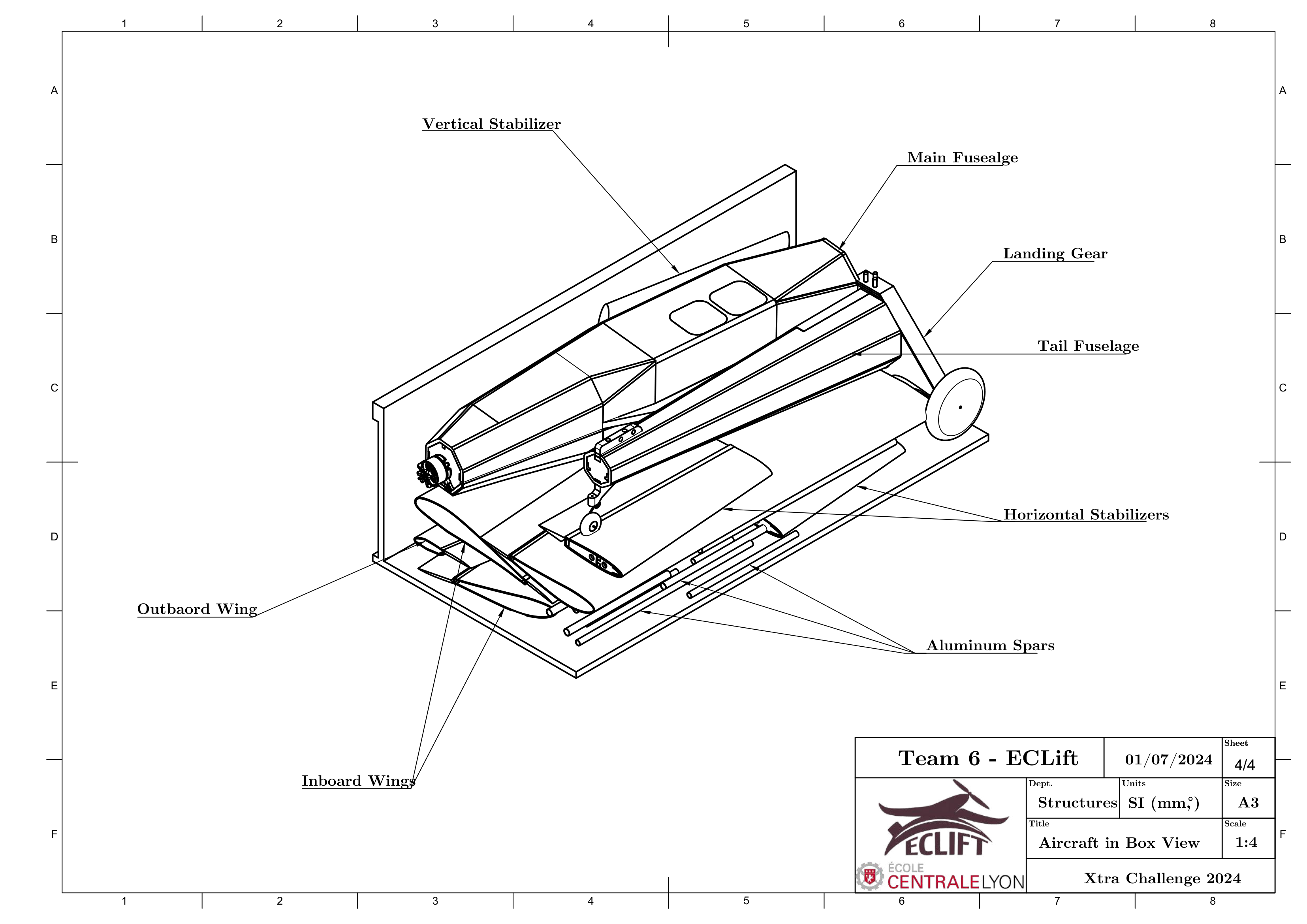
The inaugural competition aircraft designed, laser-machined, built, and flown by aerospace engineering master students at École Centrale de Lyon. Engineered under the strict regulations of XtraChallenge 2024 (2nd edition) to carry maximum payload over a 400 m pylon circuit within a 5-minute window and pack completely into a regulatory 750 mm wooden transport container. The airframe relies entirely on classic precision woodworking—laser-cut 5 mm, 4 mm, and 3 mm aviation birch plywood, shaped balsa skins, water-soaked curved leading edges, 8 mm aluminum joiners, and Oracover thermoforming shrink film.
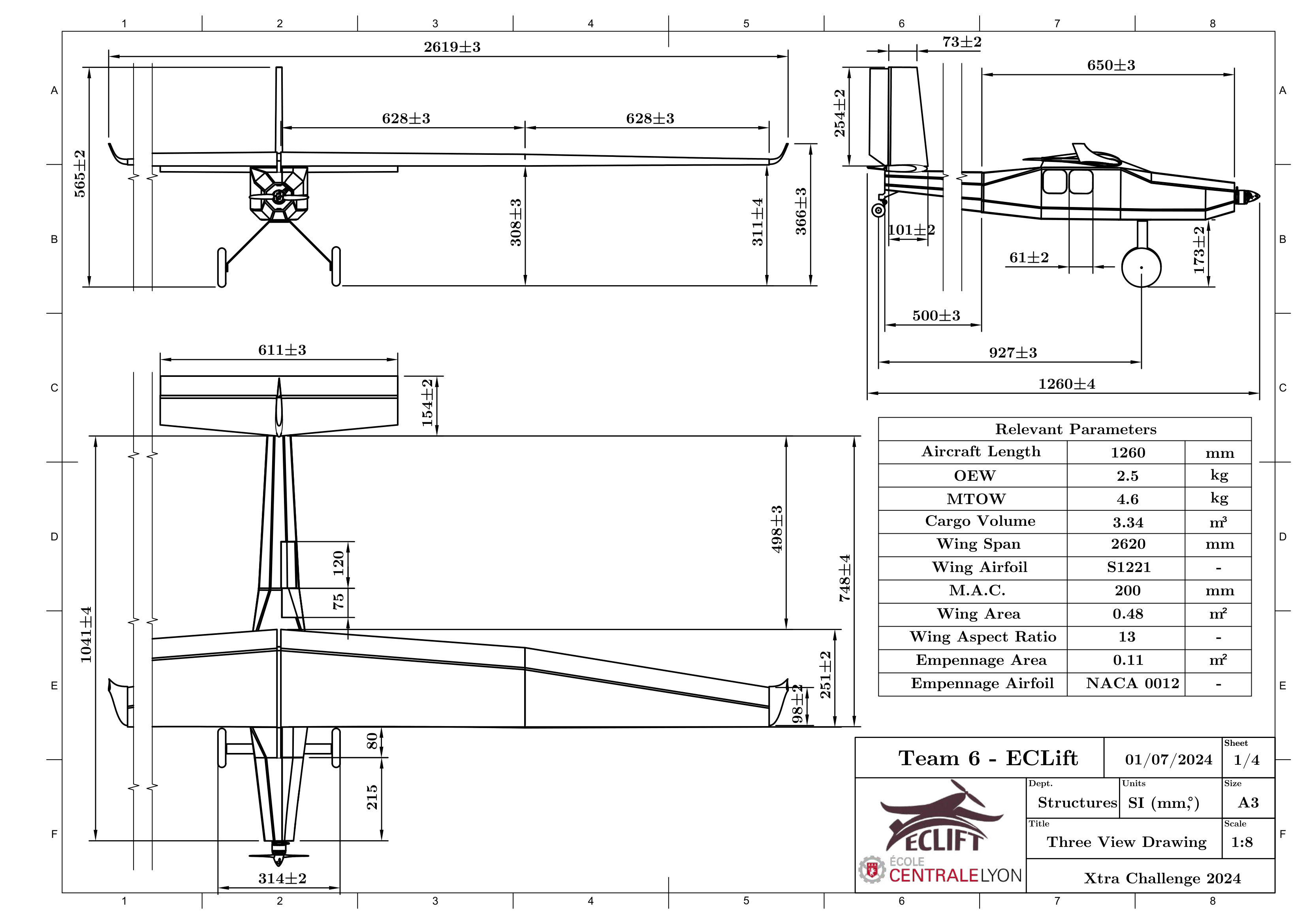
Certified 3-View Engineering Blueprint
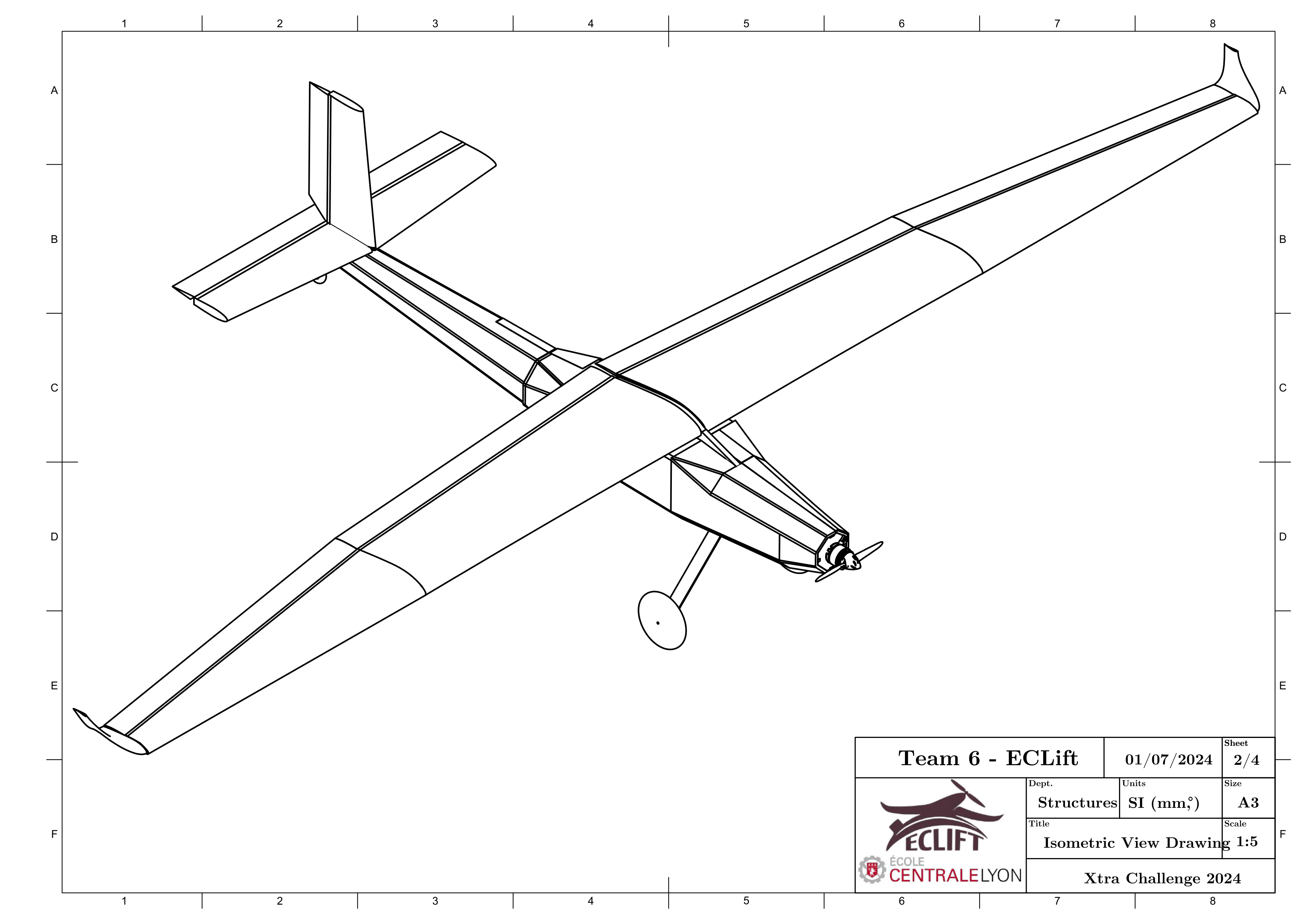
Annex II · Sheet 1/4Official scale 1:8 three-view engineering drawing submitted to the XtraChallenge 2024 jury. Displays dimensioned top view, front view, and side view with wing chord distributions, dihedral angle, landing gear stance, and empennage geometry.
European Champions in Valencia
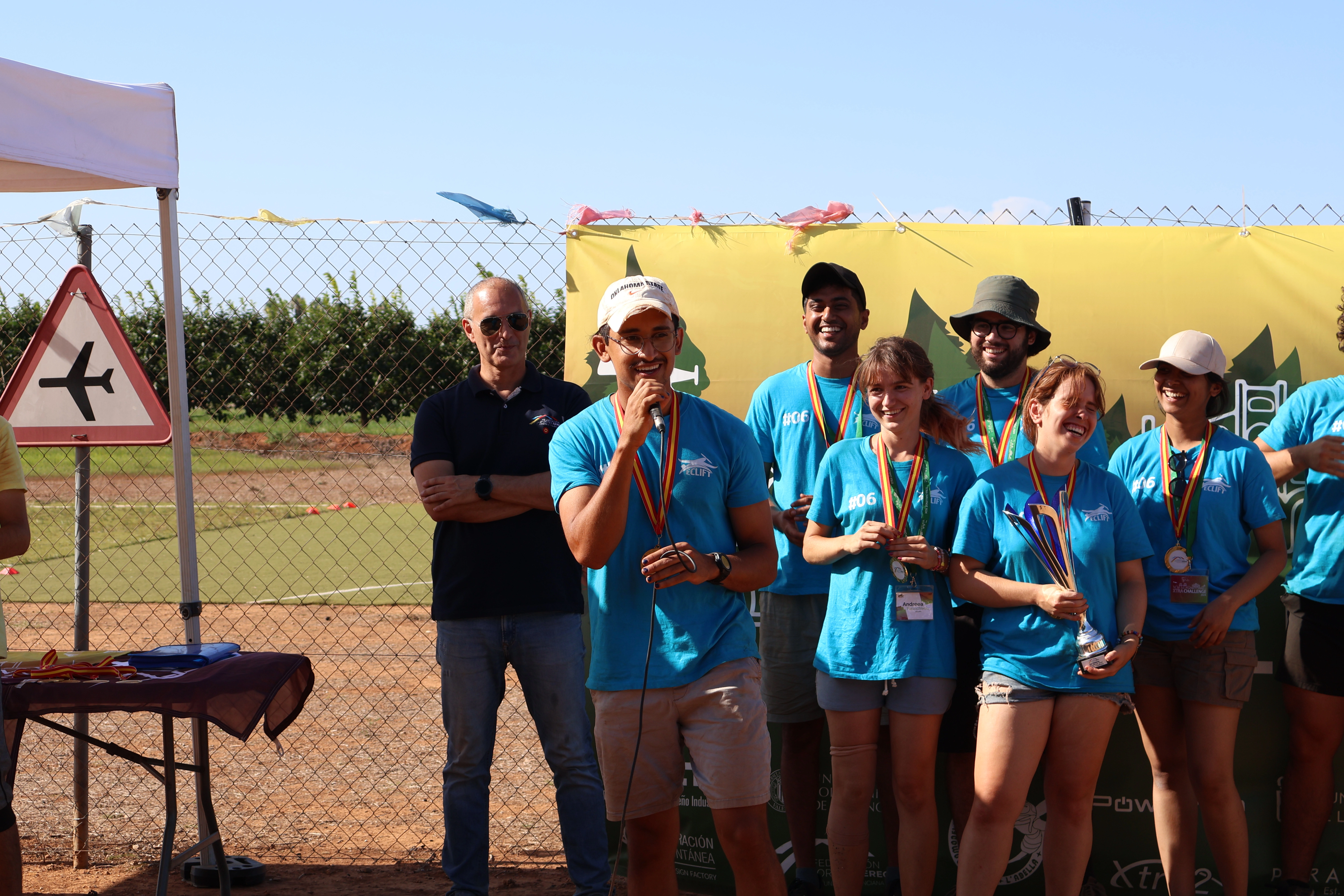
1st Prize Trophy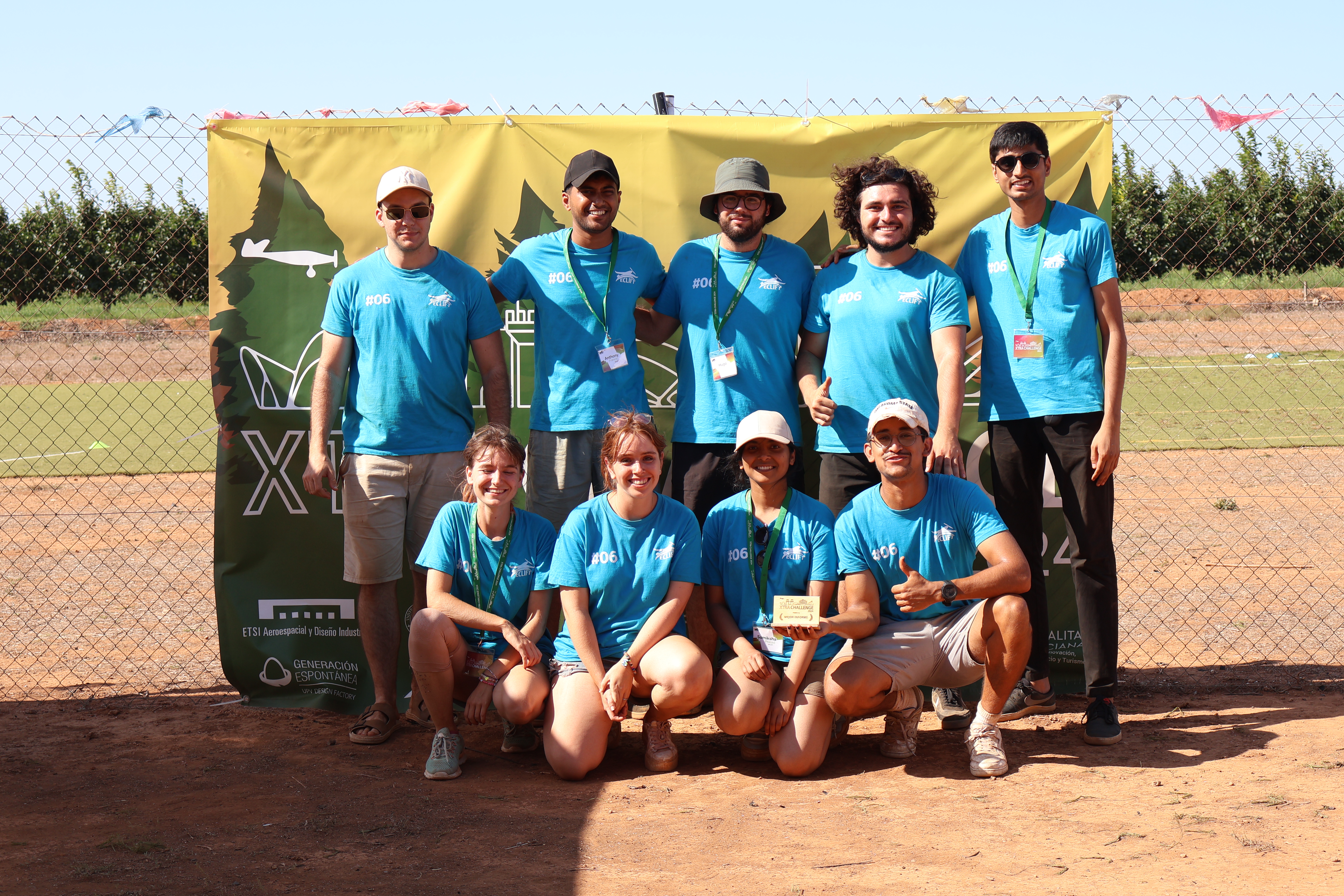
Historic Victory: Competing against premier aeronautics universities across Europe at the Universitat Politècnica de València (UPV) airfield on July 23–26, 2024, ECLift captured 1st Place Overall with a competition-record payload lift of 2.19 kg.
The international jury praised ECLift for its rigorous design methodology, complete certified technical reporting, and extraordinary engineering resilience demonstrated during a 48-hour emergency rebuild after an initial flight test incident.
Selig S1221 High-Lift Profile & Aerodynamics
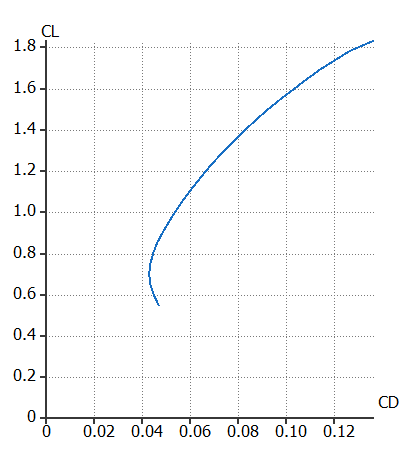
Selig S1221 AirfoilThrough comprehensive XFLR5 analysis at Re = 200,000, the Selig S1221 cambered high-lift airfoil was selected from seven candidate profiles evaluated in the range of 10%–12.5% thickness and 5%–8% camber. It delivers an exceptional maximum lift coefficient of CL,max = 1.829 with slotted flaps (1.471 clean), a wide lift-to-drag ratio spanning [20, 70] across angles of attack from 0° to 20°, and steady climb authority under maximum payload loading.
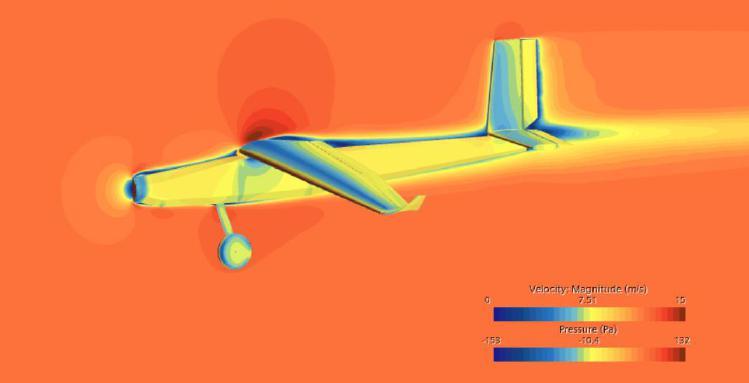
Star-CCM+ CFD validated tip fences: ΔCL = +0.02 with minimal induced drag penalty.
High camber profile tailored for low Reynolds number Re = 200,000 flight regimes.
Aerodynamic & Planform Sizing
Technical SpecsKey geometric and aerodynamic parameters derived from Section 4 and Table 3 of the certified 2024 Technical Report:
All-Wood Structural Engineering & FabLab Craftsmanship
Laser-cut aviation birch plywood, balsa sheeting, water-formed leading edges, and aluminum spar joiners
Why Wood? The Engineering Strategy of Section 7 & 9
As documented in Section 7 of the official Technical Report: "The primary materials used in the creation of the ECLifter was wood (balsa, ply, MDF), lightweight PLA, adhesives (CA, wood glue, hot glue), and various other plastics. The most used material was the 5mm plywood. This strong and tough wood constitutes the backbone of the aircraft."
Compared to typical RC wooden aircraft requiring over 300 parts, ECLifter leveraged precision laser machining at the École Centrale de Lyon FabLab to create a simplified, interlocking monocoque framework under 150 parts. This yielded exceptional strength, low hardware costs (€897.50 total materials), rapid assembly, and unparalleled field reparability under competition pressure.
Primary load-bearing spine (Plywood 50/10): 4 longitudinal stringers, 6 formers, 4 main bulkheads, firewall motor mount, and landing gear belly reinforcement plate. Laser-machined with interlocking tabs (>40 min laser cycle per sheet).
4 mm birch plywood forms the tail body frame (4 stringers, 2 formers, 3 bulkheads). 3 mm & 0.6 mm birch plywood is used for all wing ribs (with pre-lasered spar holes and alignment guides), rib doublers, and square spar caps.
5 mm balsa skins the lower fuselage belly to absorb touchdown impact energy. Control surfaces (ailerons, slotted flaps, elevator, rudder) are shaped from 5 mm balsa sanded to wedge profiles. 4 mm balsa covers the upper fuselage and tail.
3 mm balsa leading edge: Soaked in water, formed around ribs over a PVC alignment jig, and dried in place. Four 8 mm aluminum tubes slide into embedded PVC sleeves to connect the 4 demountable wing panels, sealed in Oracover film.
Photographic Evidence & Exploded CAD Dossier (Click to View High-Resolution)
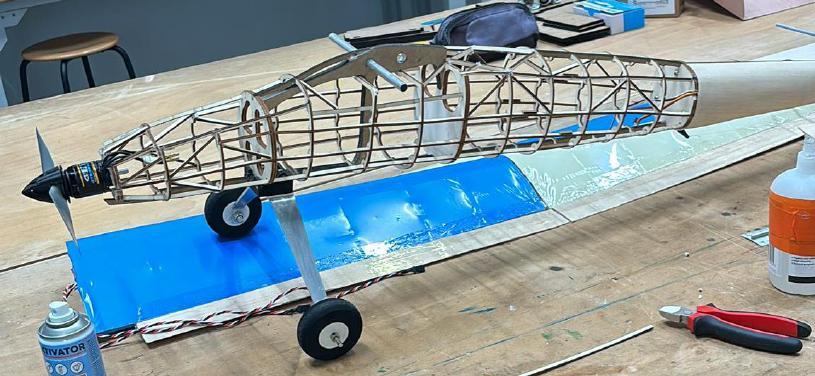
Wood Internal Skeleton
Birch plywood bulkheads & balsa skin (Fig. 29).
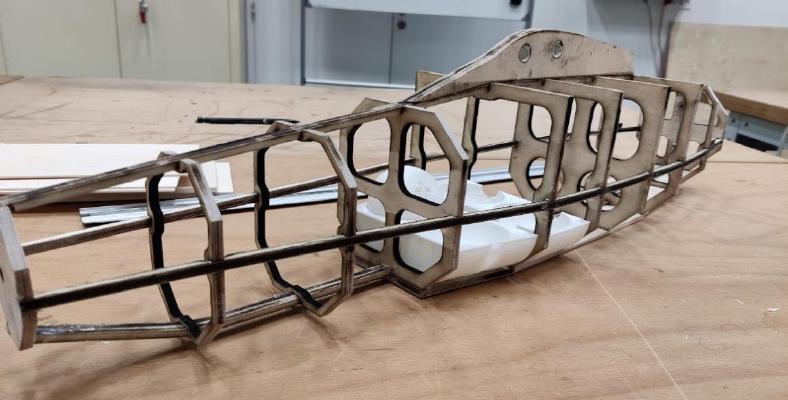
FabLab Wood Machining
Fuselage laser-cut wood assembly (Fig. 30).
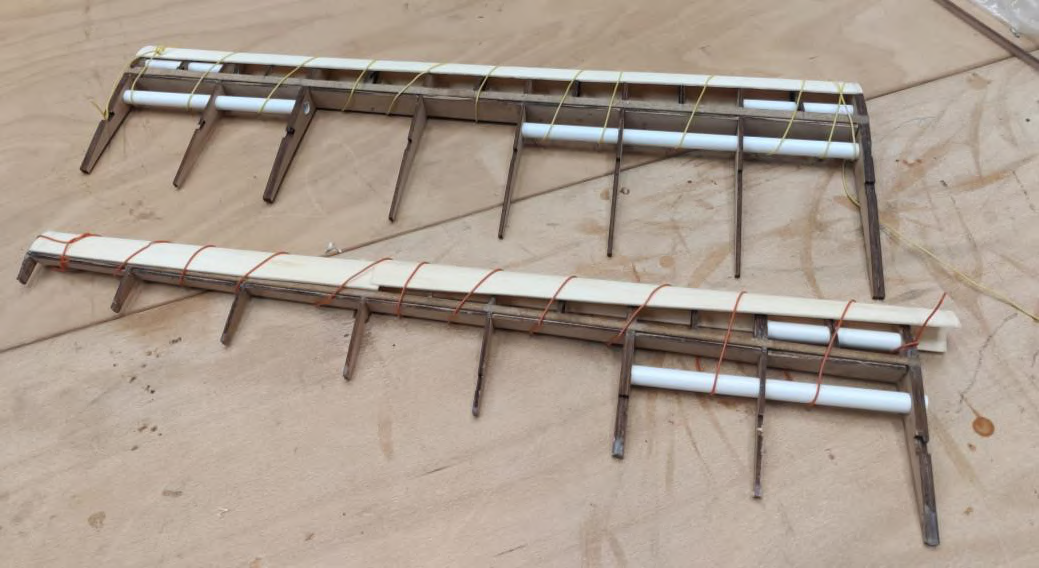
Water-Soaked Balsa
Forming balsa nose profile over ribs (Fig. 31).
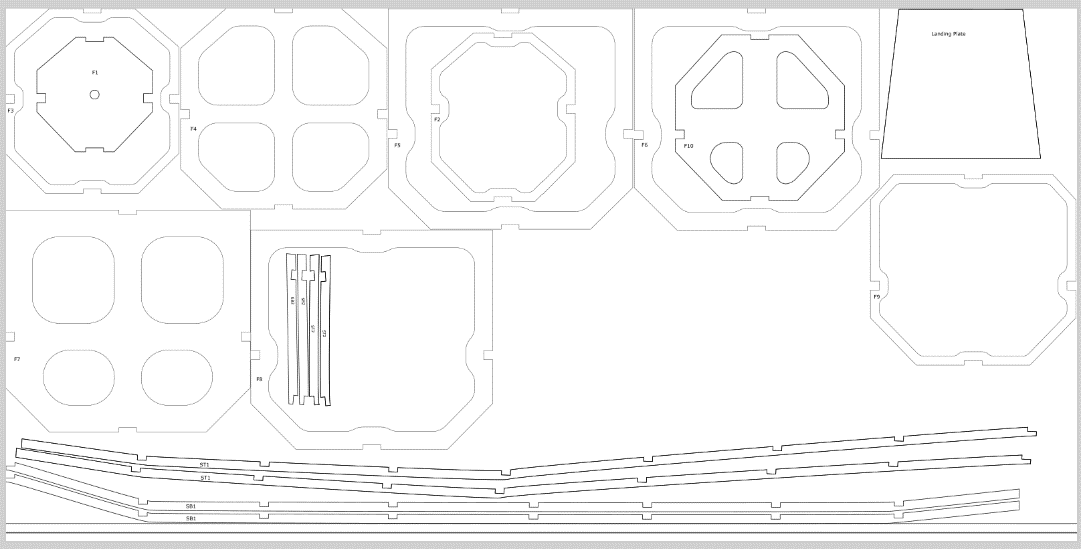
Laser Nesting Layout
5mm aviation plywood DXF nest (Fig. 28).
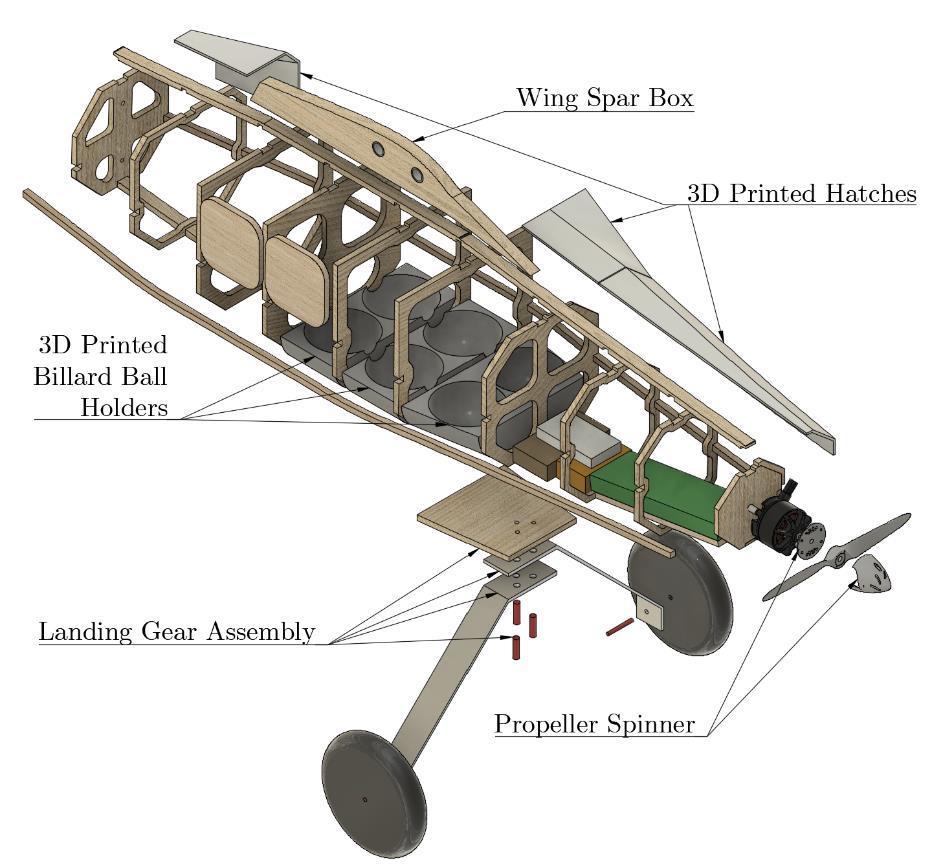
Main Fuselage CAD
Plywood formers, bulkheads & bays (Fig. 19).
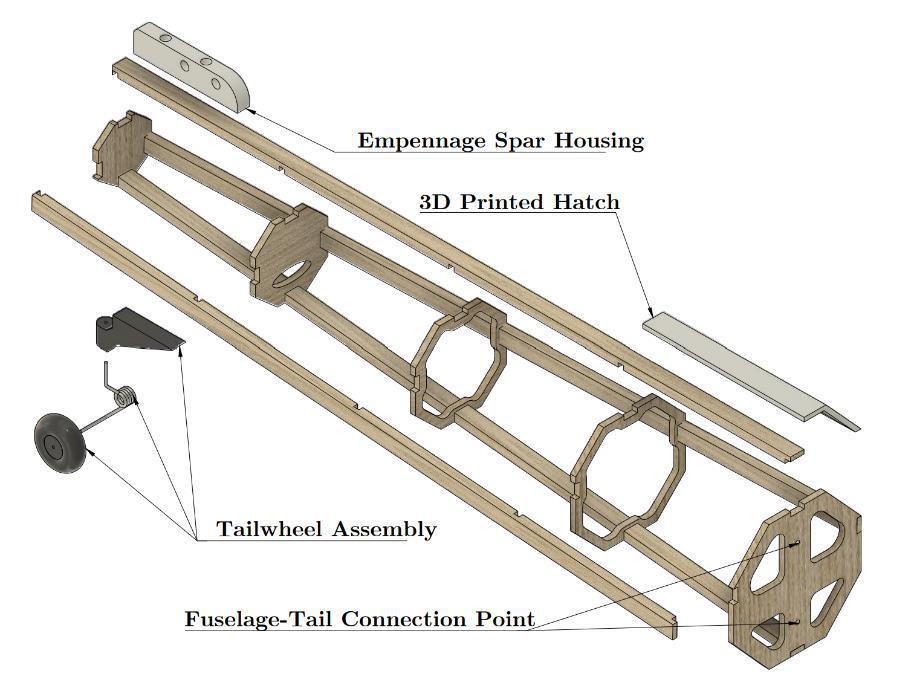
Tail Body CAD
4mm ply tail frame & 20-ball bay (Fig. 20).
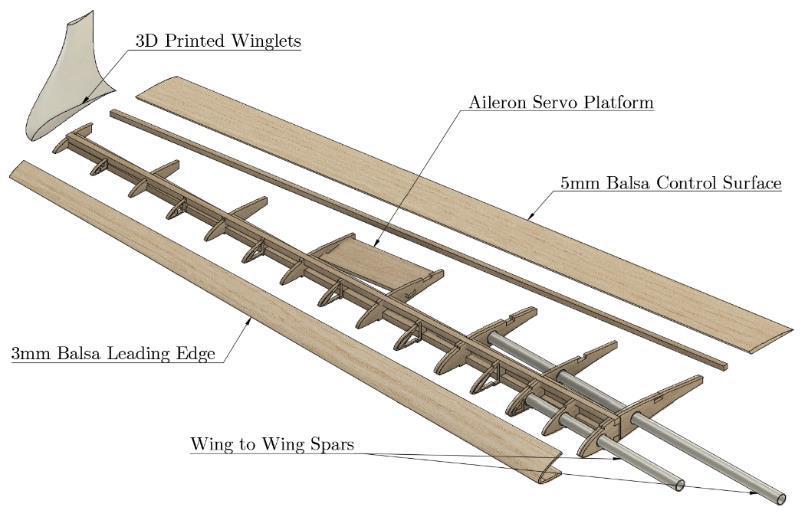
Inboard Wing CAD
3mm ribs, 8mm joiners & flap (Fig. 21).
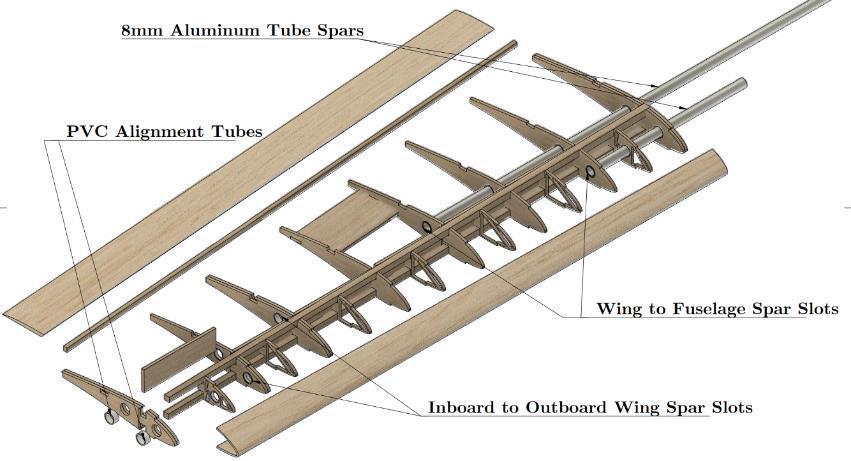
Outboard Wing CAD
Aileron bay & 3D PLA sharklet (Fig. 22).
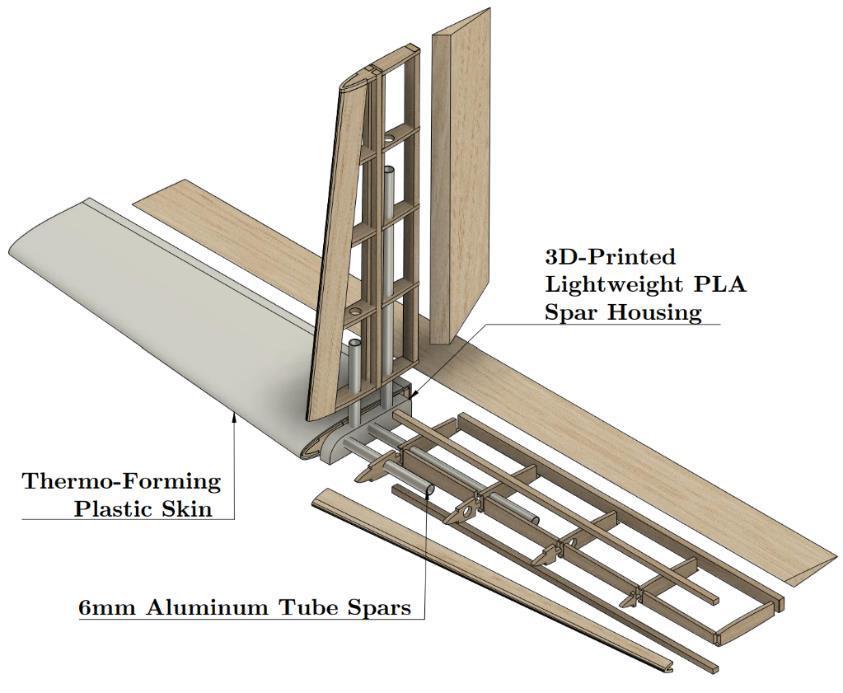
Empennage CAD
6mm aluminum spars & surfaces (Fig. 23).
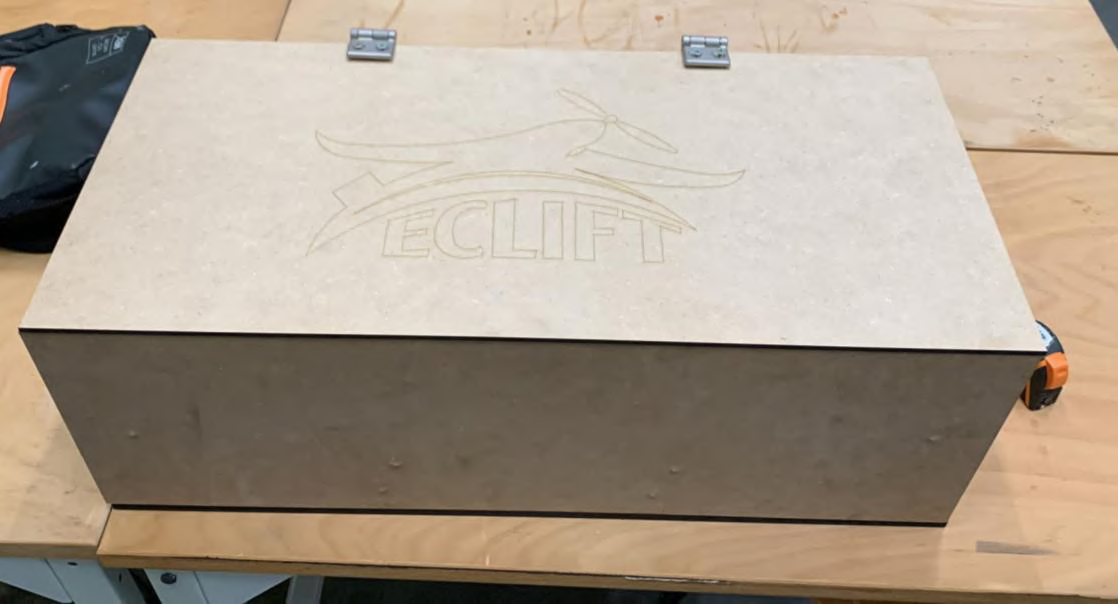
750 mm Wooden Box
Demountable storage crate (Fig. 27).
COMSOL Multiphysics Static Structural FEA
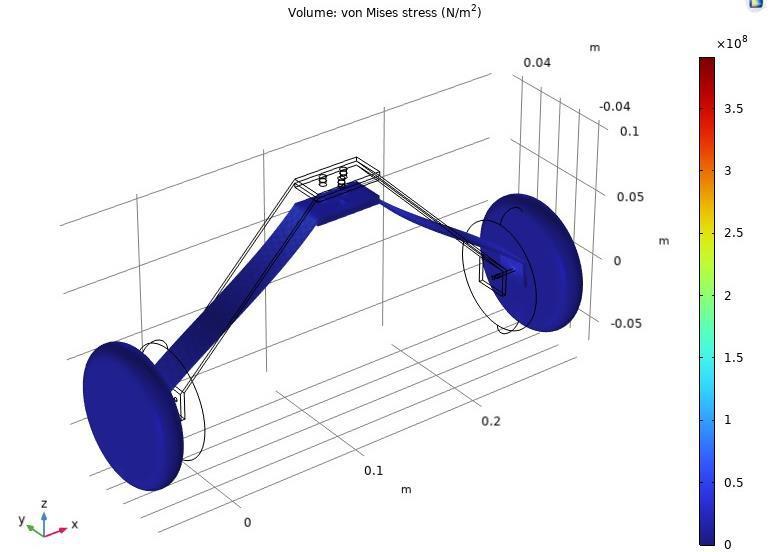
Peak stress 440 MPa on wheel connector bolt under full MTOW touchdown (Fig. 25).
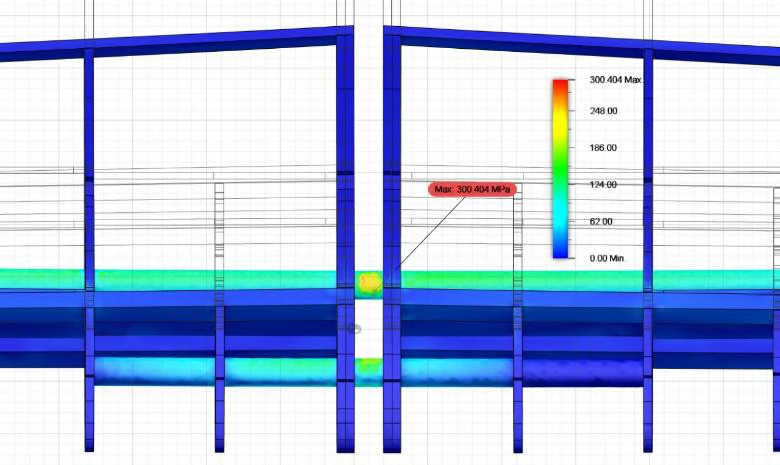
Peak stress 300 MPa on 8mm aluminum rod joiners under maximum positive G load (Fig. 26).
Dual Cargo Payload Architecture
Strategic mass distribution & rapid loading under competition rules (2.19 kg record lift)
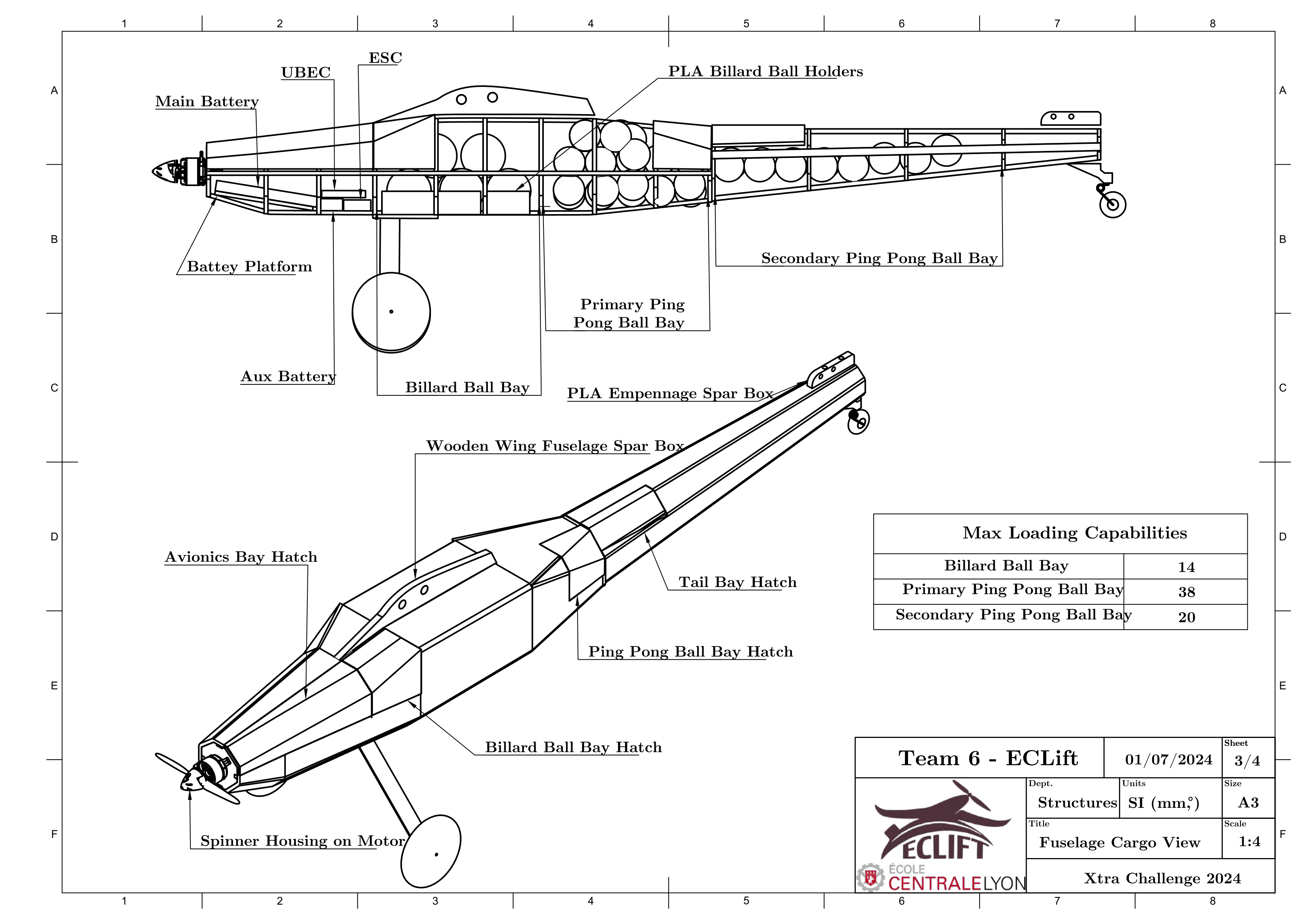
Precise longitudinal partitioning of the airframe into 4 distinct compartments: forward Avionics Bay, central Billiard Ball Bay directly on the Center of Gravity, Primary Ping-Pong Ball Bay in the main fuselage, and Secondary Ping-Pong Ball Bay in the tail body.
Directly positioned beneath the wing at the aircraft Center of Gravity (xCG = 7.6 cm from LE). Designed for up to 14 balls, competition configuration carried 6 to 8 regulation billiard balls (160–165 g each, Ø57 mm) in 3D-printed lightweight PLA "egg carton" cradles secured by elastic rubber bands.
Because this dense heavy mass sits precisely along the neutral balance point, loading or unloading billiard balls produces zero longitudinal CG displacement and zero pitch trim change (validated in Report Figure 24).
Exploits internal airframe volume across two sections: 38 balls in the primary rear main fuselage cavity + 20 balls in the secondary tail body cavity = 58 balls total (2.7 g each, Ø40 mm). Designed as open stuffing cavities without individual dividers for sub-10 second loading under competition stopwatch.
3D-printed PLA hatches secured by neodymium magnets embedded into recessed balsa corners, ensuring smooth rapid opening without snagging hands or tape.
Powertrain & Instrumented Thrust Bench
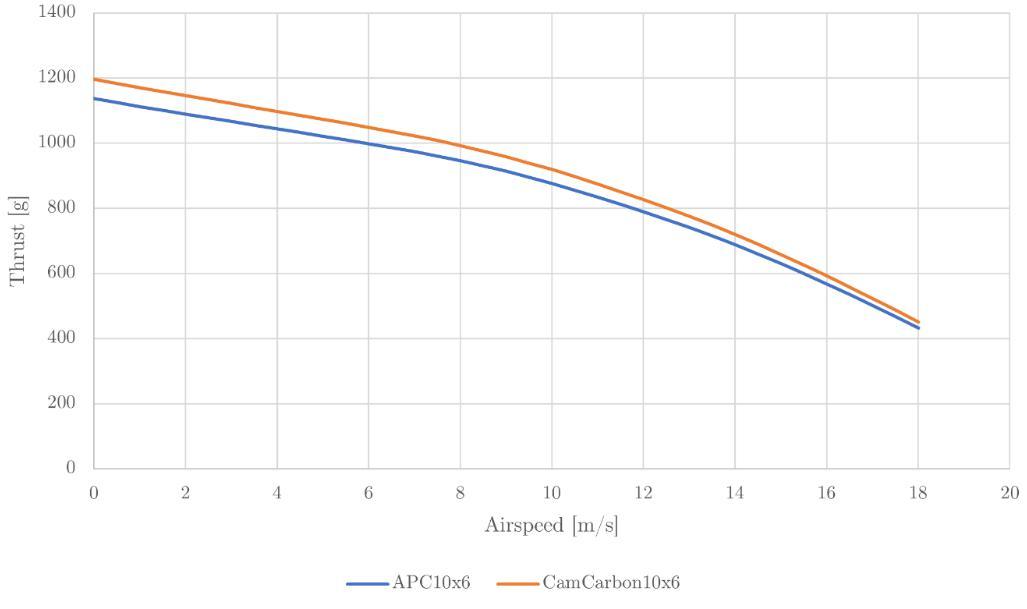
1,079 g Static ThrustDriven by the imposed Emax GT2820/06 (985 KV) brushless motor bolted to the 5 mm plywood firewall with direct airflow cooling. Propeller selection was validated experimentally on a custom in-house L-arm static thrust test stand: the lightweight resistant plastic APC 10x6E propeller yielded 1,079 g of static thrust at 11.1V and was chosen over the Aeronaut CamCarbon alternative for its lower cost (€4.60) and superior impact tolerance on rough grass landings.
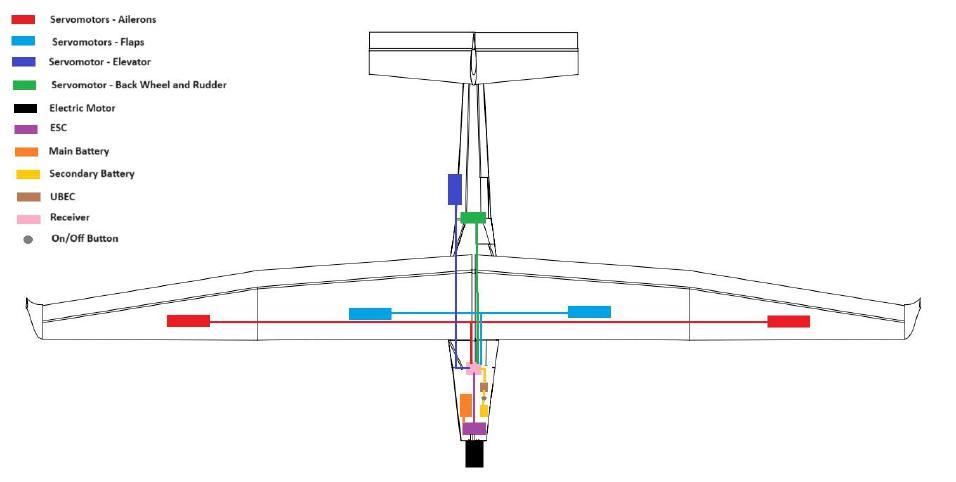
Over-dimensioned speed controller supporting 50A continuous current with advanced firmware.
Low internal resistance 20C LiPo sized for 3000 mAh minimum requirement over 300 s mission.
Dual Isolated Power Architecture
Fail-Safe DesignTo eliminate any risk of radio brownout or control loss during maximum throttle bursts, the team implemented a strictly isolated dual-battery power bus architecture in accordance with Section 3.2 of the Technical Report:
SLS X-Tron 3S 3200 mAh 20C LiPo directly feeds the Skywalker 50A V2 ESC and Emax GT2820/06 motor via heavy-gauge silicone wiring with XT90 connectors.
A separate 2S 500 mAh 45C LiPo battery feeds a dedicated UBEC 4A (5V) regulator, powering the radio receiver and all 6 metal-gear EMAX ES3004 servos (17 g, 3.5 kg·cm torque). Complete electrical isolation prevents motor-induced voltage sags from disrupting flight controls.
The 2024 Campaign: From Maiden Crash to European Victory
How technical rigor, telemetry diagnostics, and an intensive 48-hour emergency sprint at the Centrale Lyon FabLab transformed an approach stall crash into an international championship triumph.
Flight 1: Maiden Success
First flight validated at Corbas airfield without payload. Longitudinal trim verified, roll response confirmed, and slotted flaps tested. Pilot noted insufficient yaw authority; vertical fin height was immediately increased.
Flight 2 Crash & Diagnostics
Stall on approach resulted in a nose-down crash. The plywood nose shattered and wing mounts broke (Fig. 35). Analysis revealed an aft CG causing spiral instability, coupled with elevator over-sensitivity (PIOs).
View Crash Photo (Fig. 35)FabLab Emergency Rebuild
In a continuous 48-hour sprint at the FabLab, the team redesigned the nose with 5 mm plywood gussets, relocated the battery to shift CG forward to 7.6 cm (14% static margin), enlarged the vertical fin to 0.03 m², programmed elevator expo, and rebuilt the wing leading edge.
Flight 3 & Valencia Victory
Flawless re-flight on June 30 with 1.8 kg payload (Fig. 36). Flown to Valencia on July 23–26 where ECLifter completed all rounds, lifted 2.19 kg record payload, and earned 1st Prize in Europe!
View Approach Photo (Fig. 36)The 2024 Champions Team Roster
The 11 founding engineers behind the ECLifter and the 2024 European trophy (Report Figure 1)
Certified Competition Reports & Blueprints 2024
Official engineering reports and certified 3-view blueprints submitted to the international jury of XtraChallenge 2024. Includes aerodynamic polars, finite element structural sizing in COMSOL, propulsion test bench calibration, bill of materials, and full workshop fabrication dossiers.
Technical Report 2024
Complete Certified Technical Dossier • PDF (2.0 MB, 48 pages)
Preliminary Report 2024
Initial Preliminary Design Dossier • PDF (405 KB, 5 pages)
Annex II Certified Engineering Drawings (Scale 1:4 & 1:8 Blueprints)
ECTanker | Season 2025
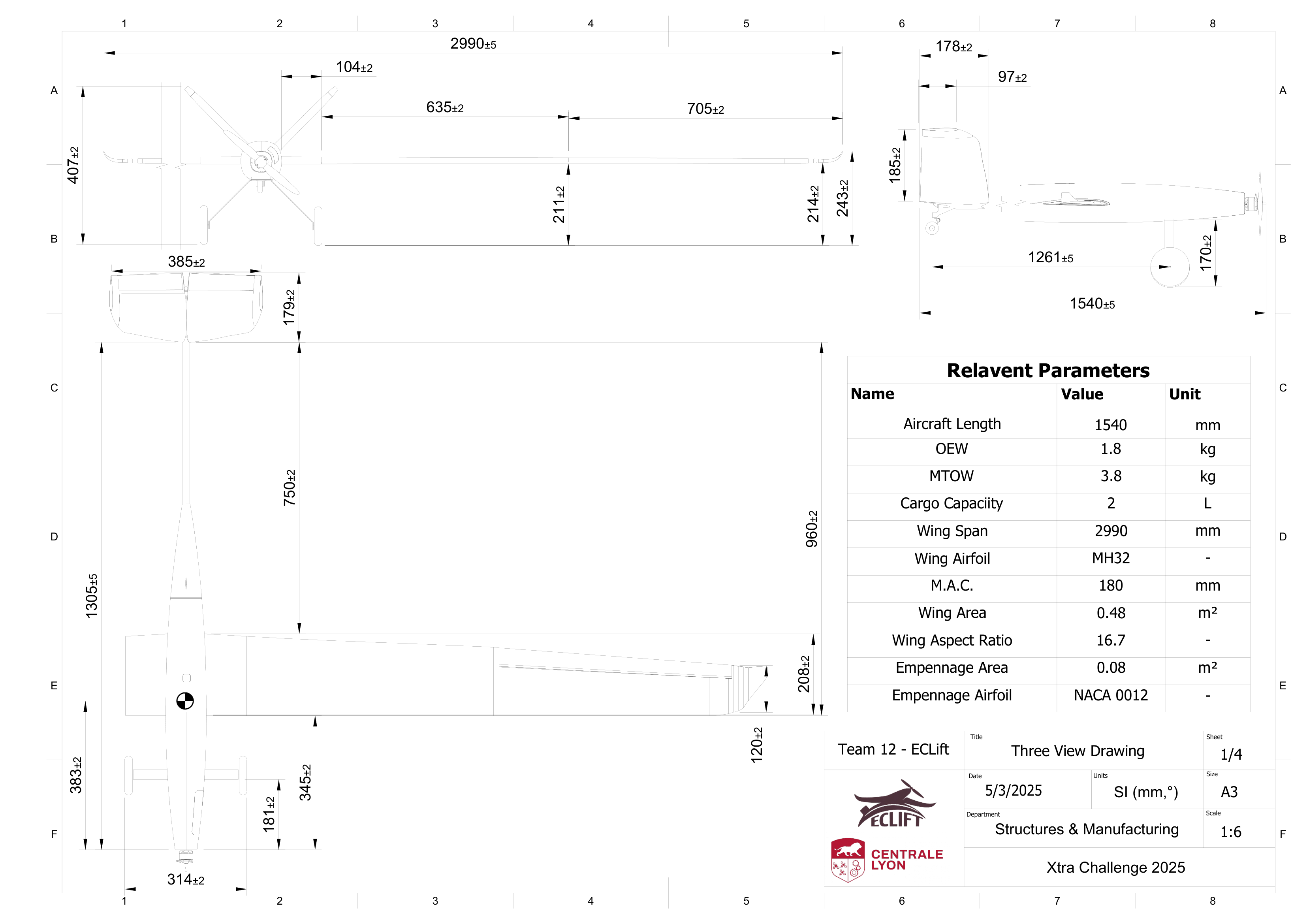
A clean-sheet composite redesign engineered by aerospace engineering students at École Centrale de Lyon for the 3rd edition of XtraChallenge in Valencia. Tailored for high-rate climb, unpowered free-glide endurance, high-speed pylon circuits, and certified to carry a 2.0-liter watertight cargo payload. Featuring a vacuum-bagged carbon/epoxy fuselage, high-aspect-ratio MH-32 laminar wings with 3D-printed sharklets, an all-moving 45° V-tail empennage, and modular disassembly into a strict 700 × 350 × 250 mm³ transport box.
Certified Engineering Blueprints
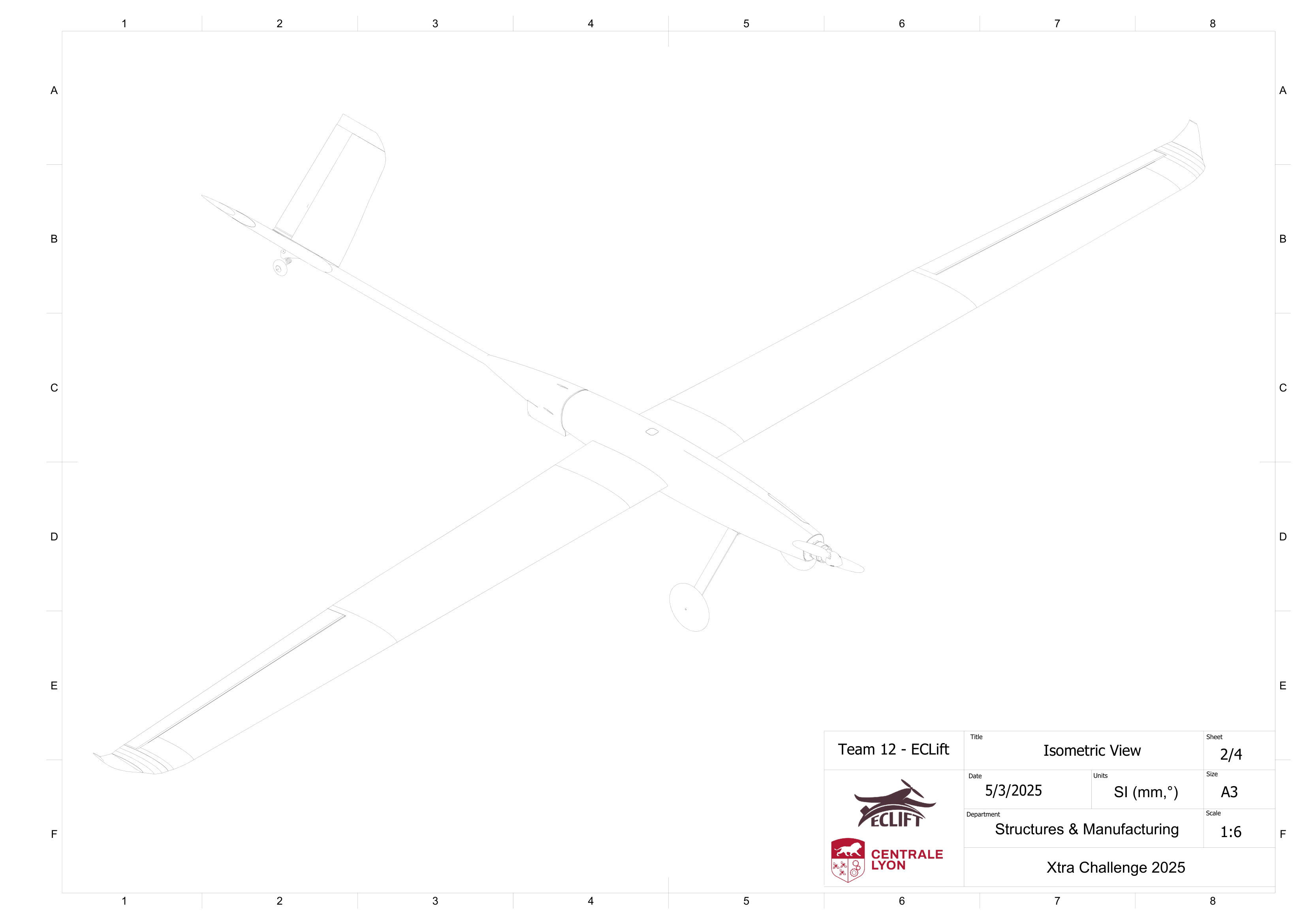
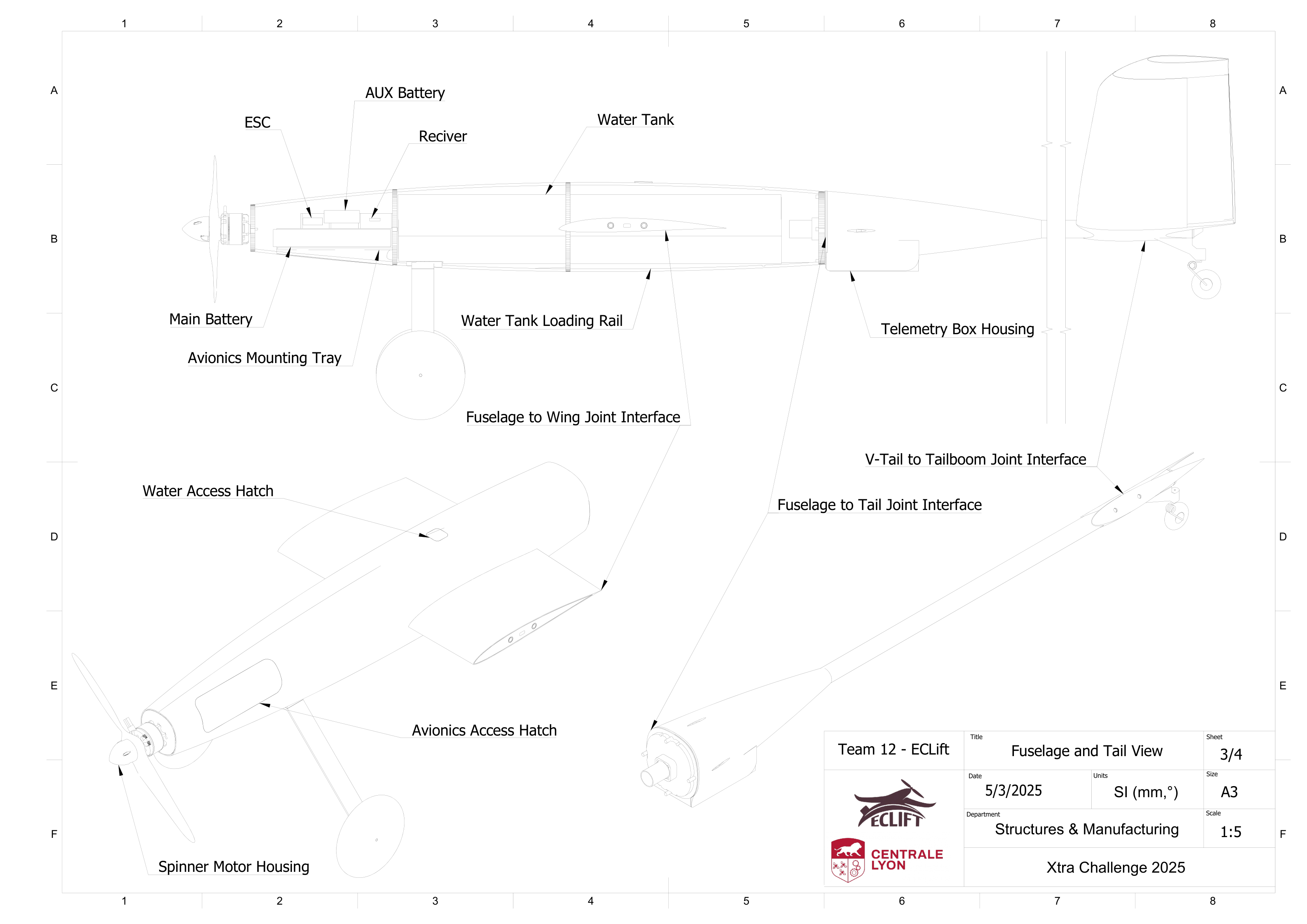
Annex II · Sheets 1 to 4Official scale 1:6 and 1:5 engineering drawings submitted to the international jury of XtraChallenge 2025. Displays fully dimensioned three-view projections, internal fuselage arrangements, water tank rails, and the regulatory 700 × 350 × 250 mm³ modular packing scheme.
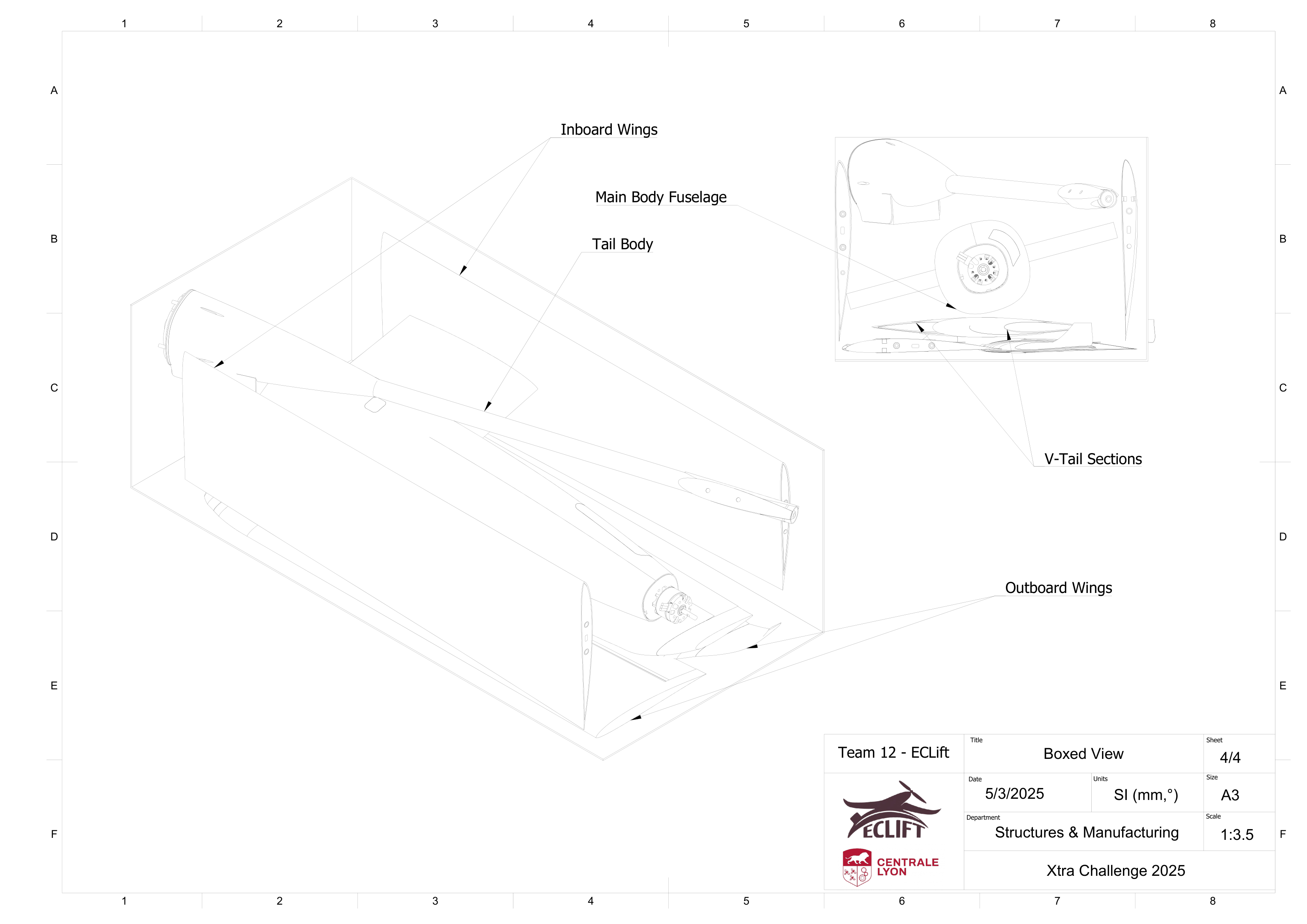
3D CAD Synthesis & Team
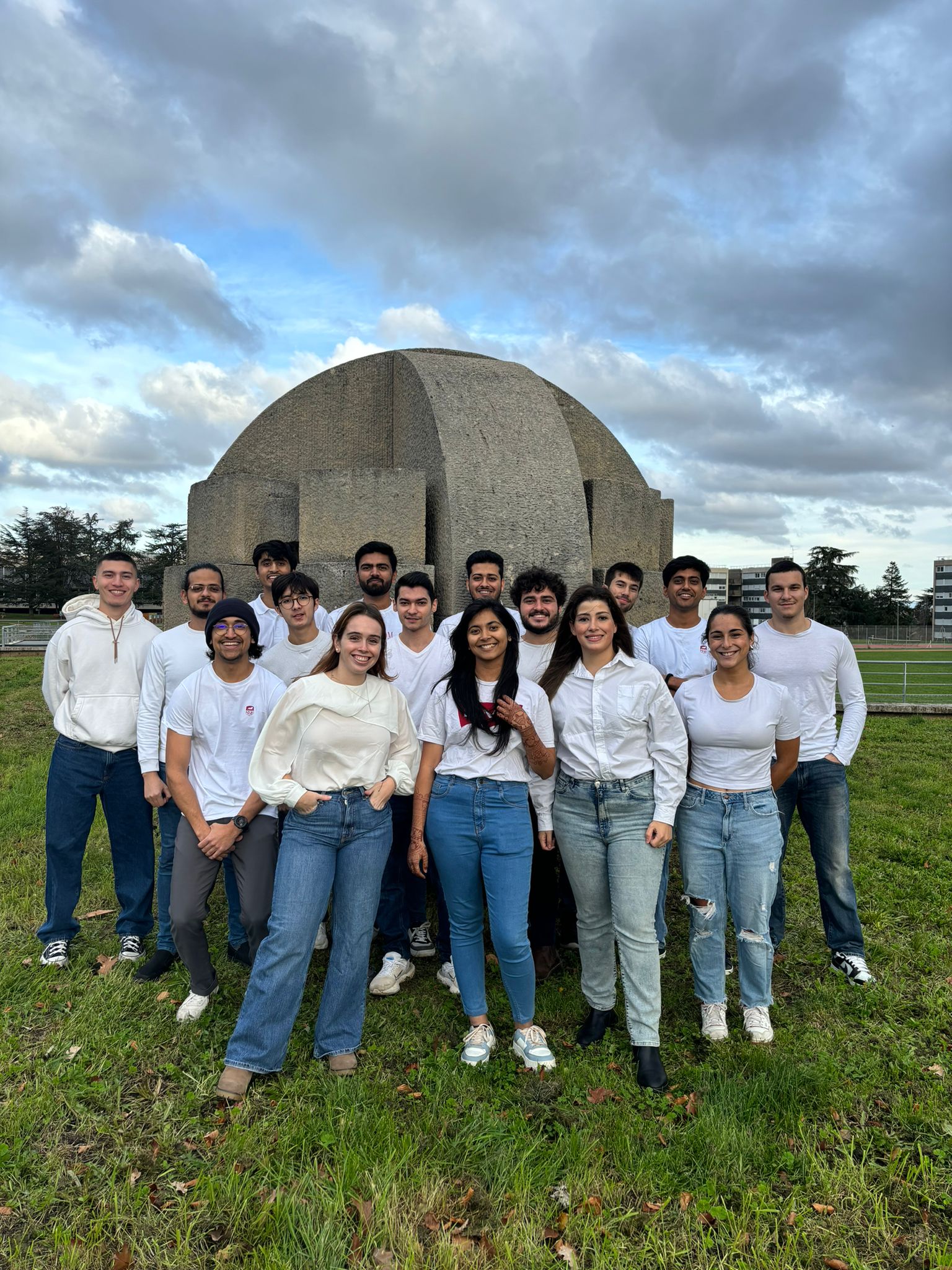
Team #12 · ECLift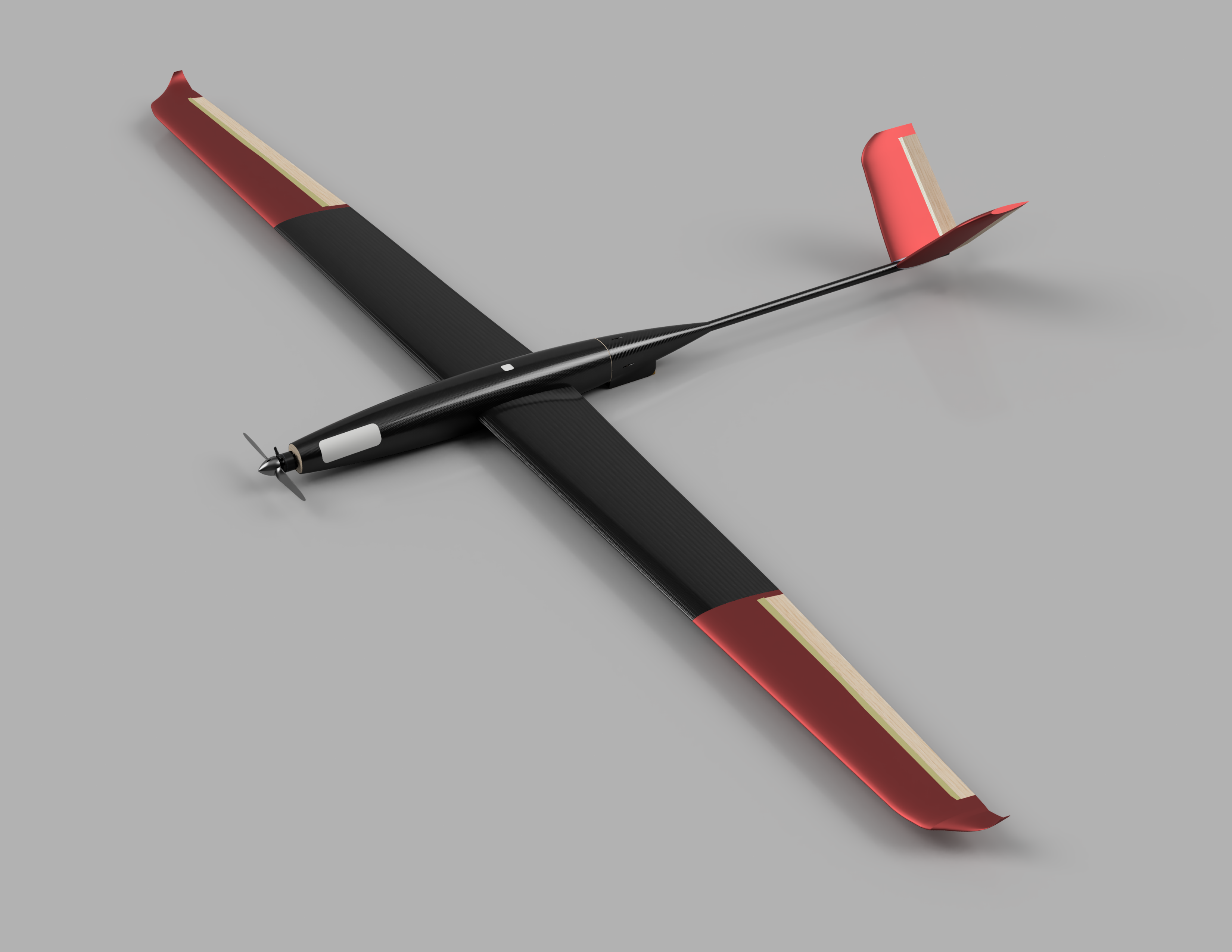
Aerodynamic Design, Airfoil Polars & CFD Analysis
MH-32 Profile Selection & Sharklet Wingtips
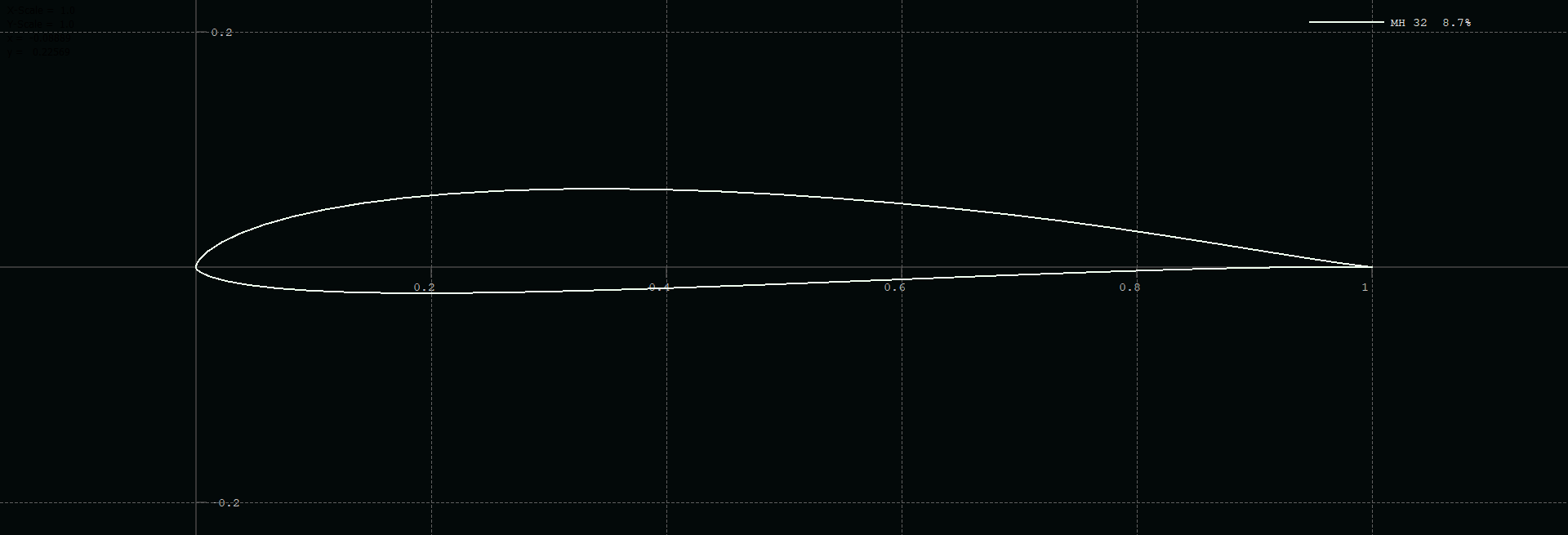
Airfoil: MH-32To excel in the unpowered free-glide phase introduced in the 2025 rules, the team selected the laminar MH-32 profile (8.74% thickness) evaluated at Re = 200,000. It exhibits a very low minimum profile drag (CD,min) and a high lift-to-drag ratio (L/D ≈ 10) at cruising glide speed, with gentle stall progression across varying angles of attack.
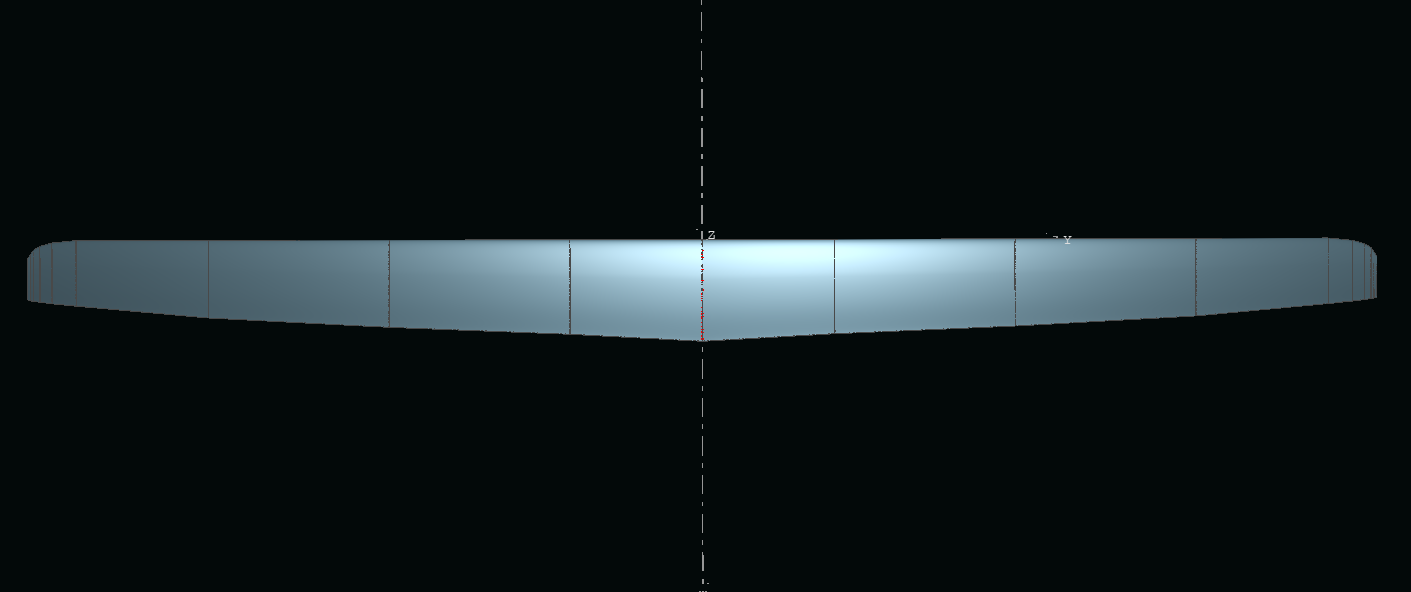
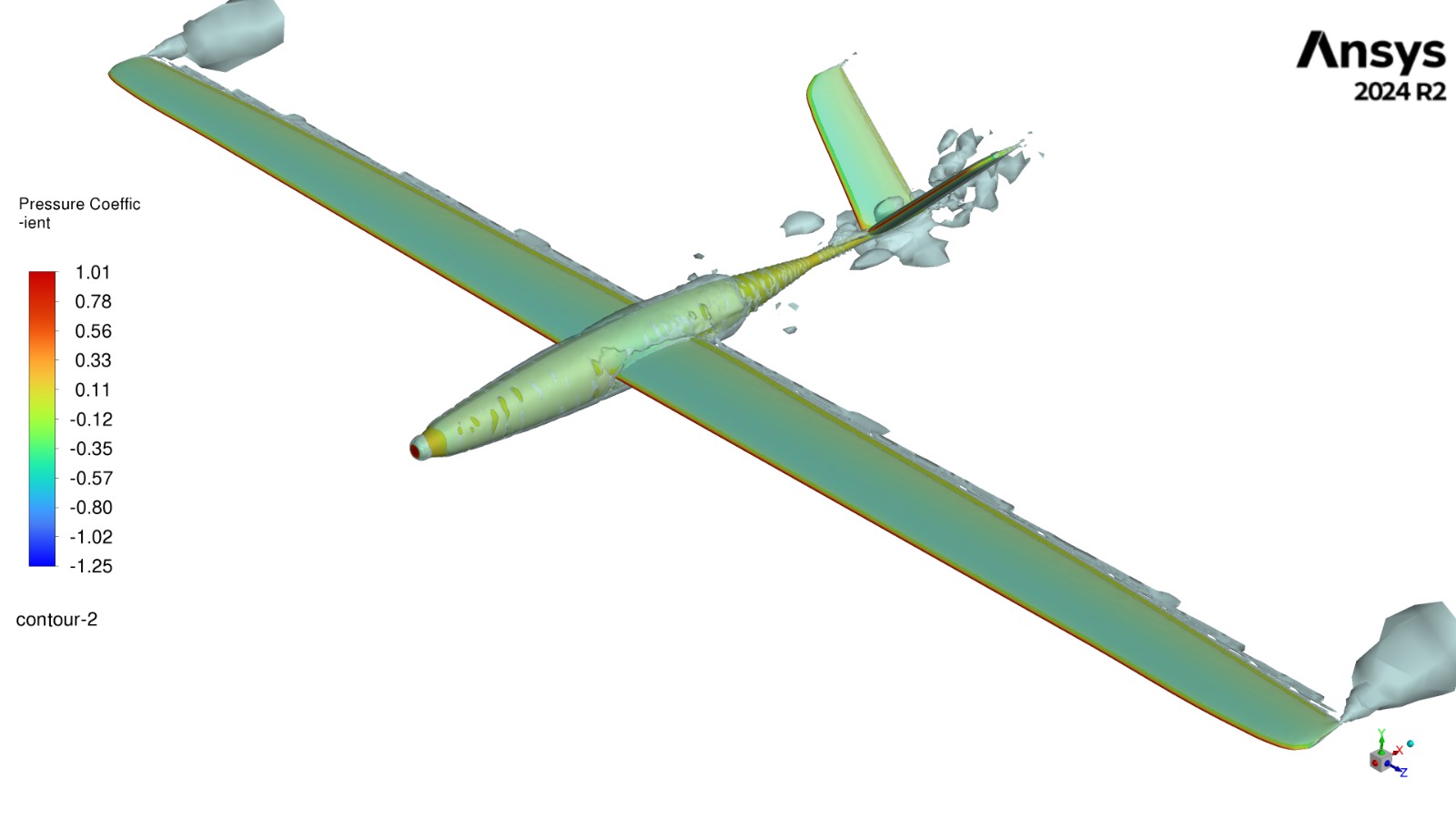
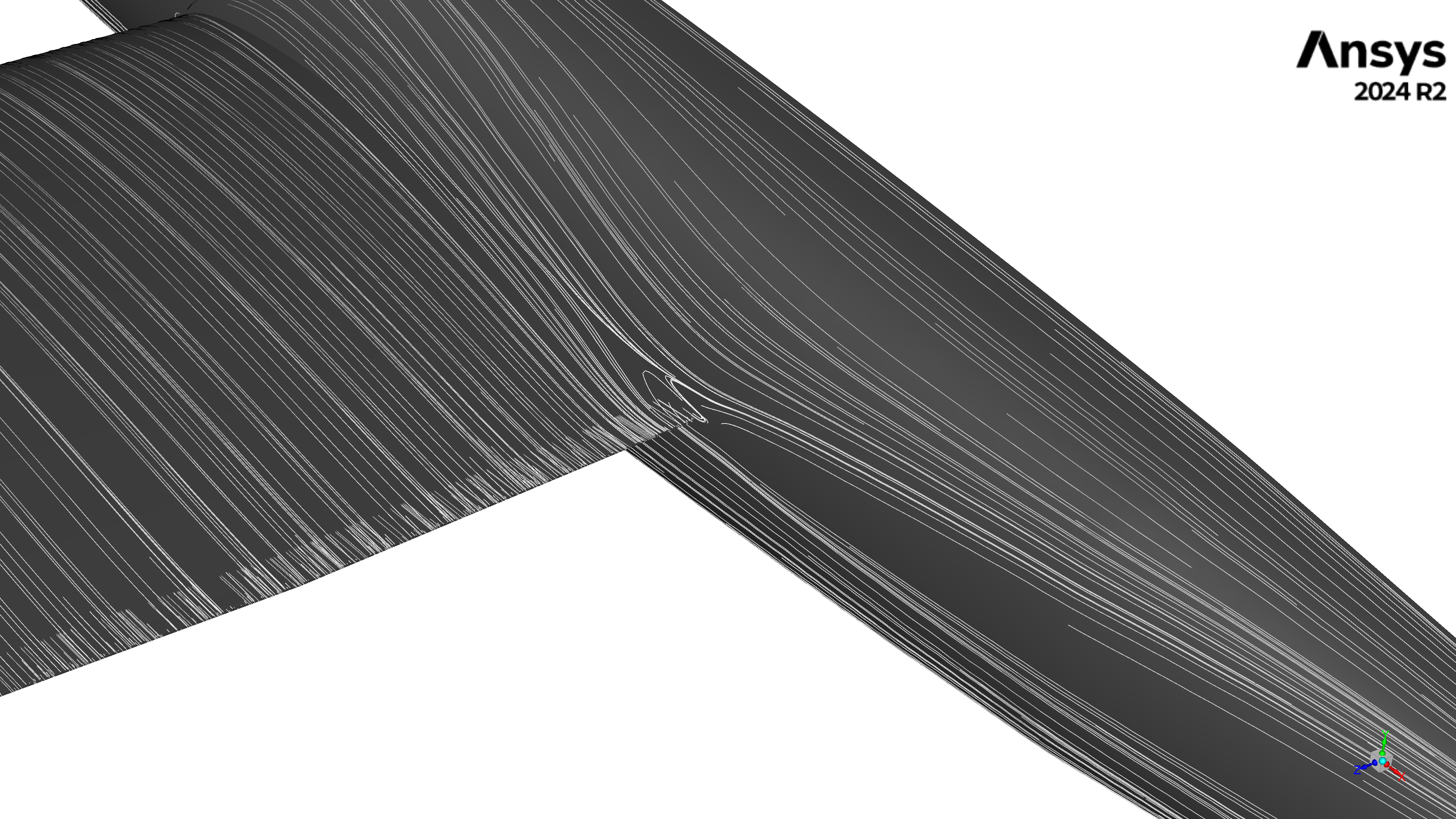
Sharklet Wingtip Optimization (Fusion 360 & ANSYS Fluent)
Baseline: CL=0.65, CD=0.012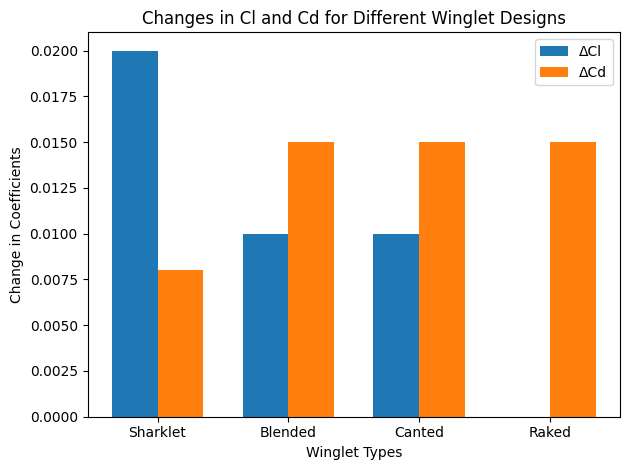
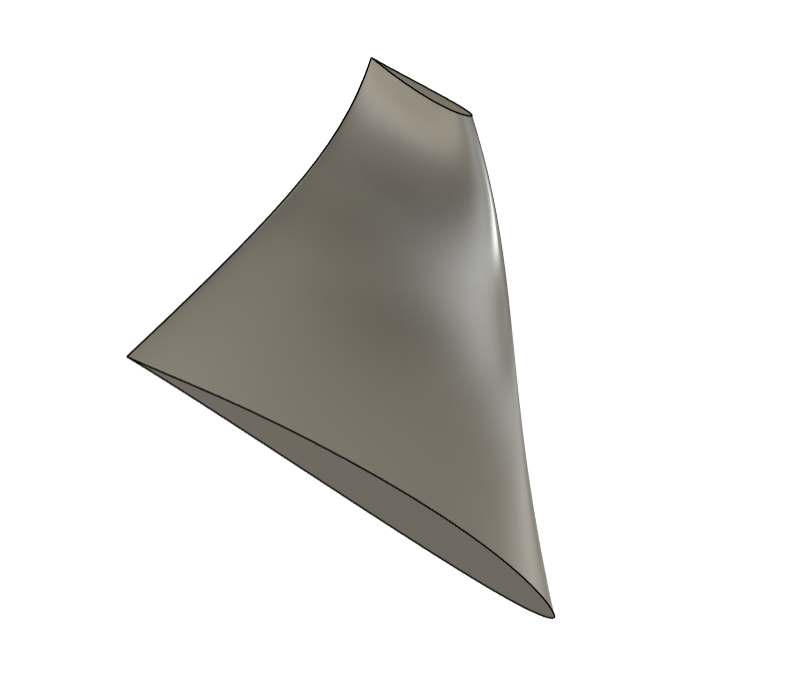
ΔCD = +0.008
ΔCD = +0.015
ΔCD = +0.015
ΔCD = +0.015
ANSYS Fluent Flow Visualizations (0° AoA, V = 10 m/s)
Report Figs. 13 & 14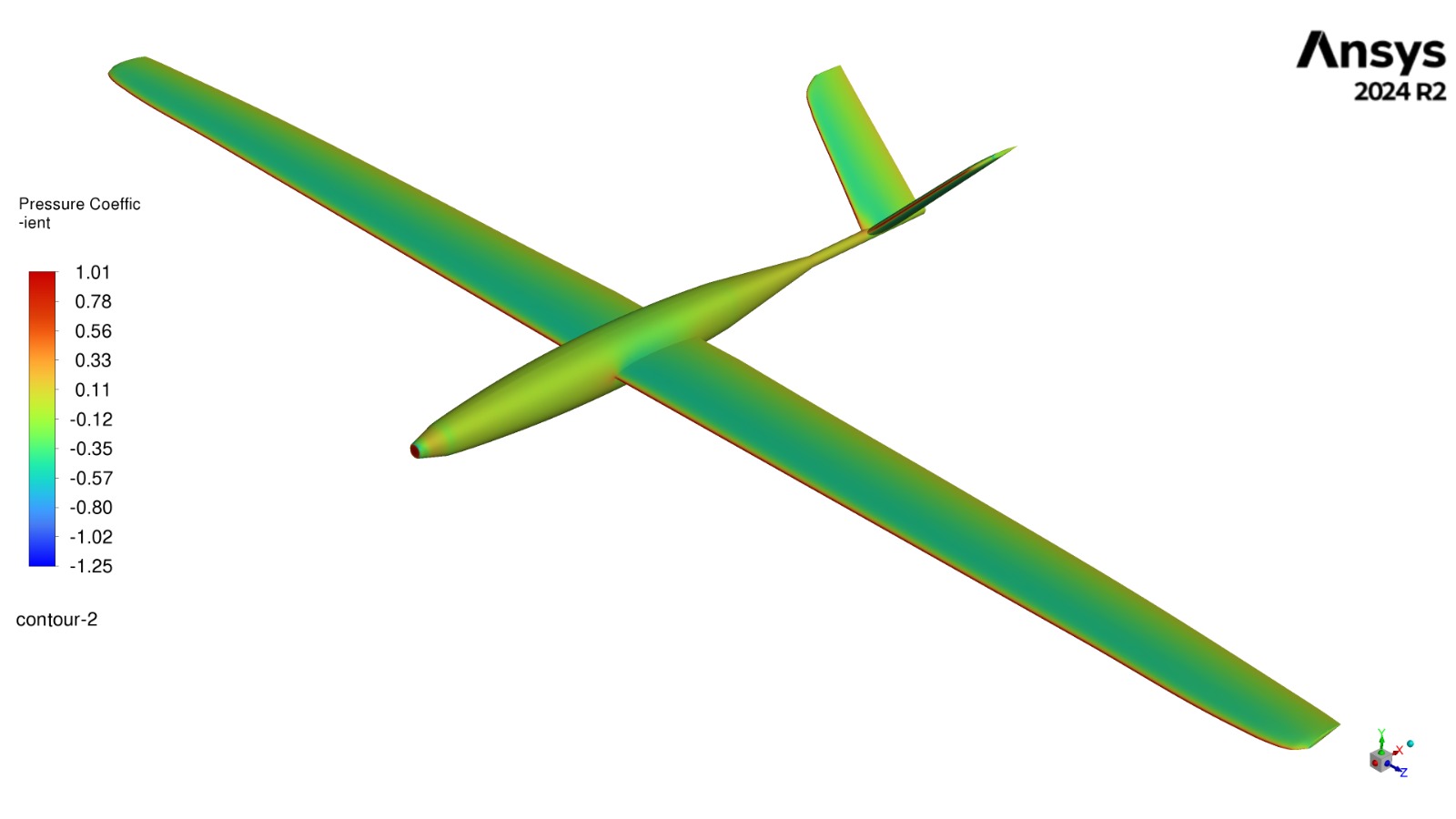
Stability & 45° V-Tail Geometry
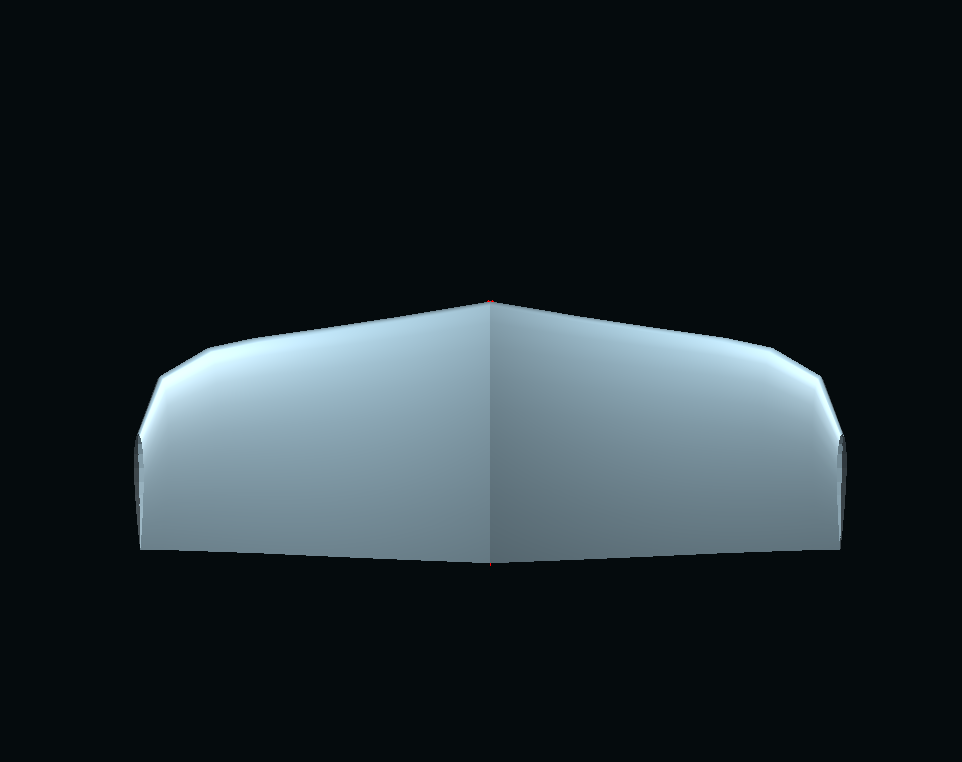
Dihedral 45°Merging the vertical fin and horizontal stabilizer into two surfaces inclined at 45° dihedral reduced wetted surface area and eliminated junction interference drag. Control is provided by mixed ruddervators actuated by high-torque digital metal-gear servos.
Composite Architecture, 3-Phase Tooling Molds & Static Test
Mold Creation & Tooling Coat
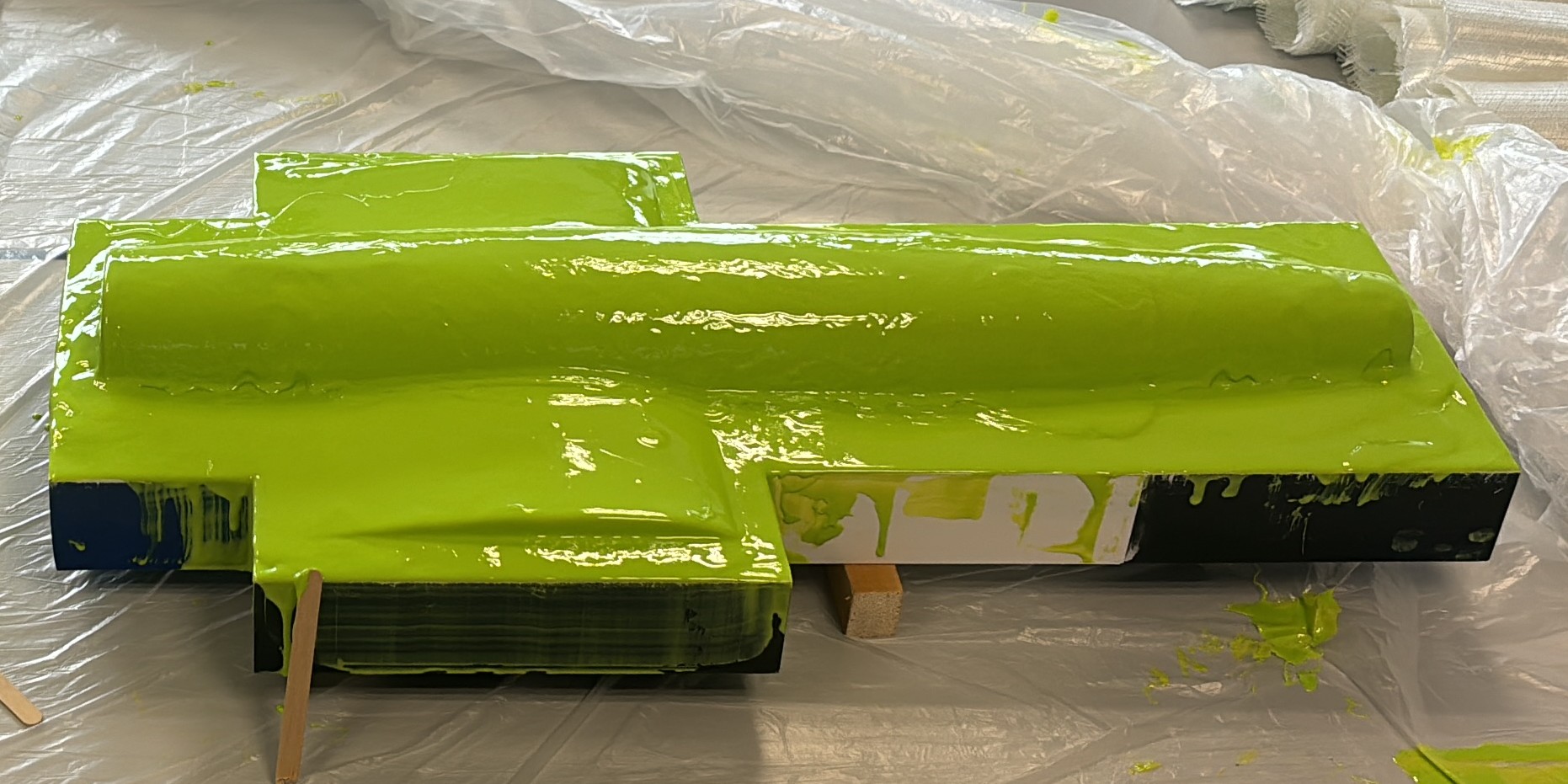
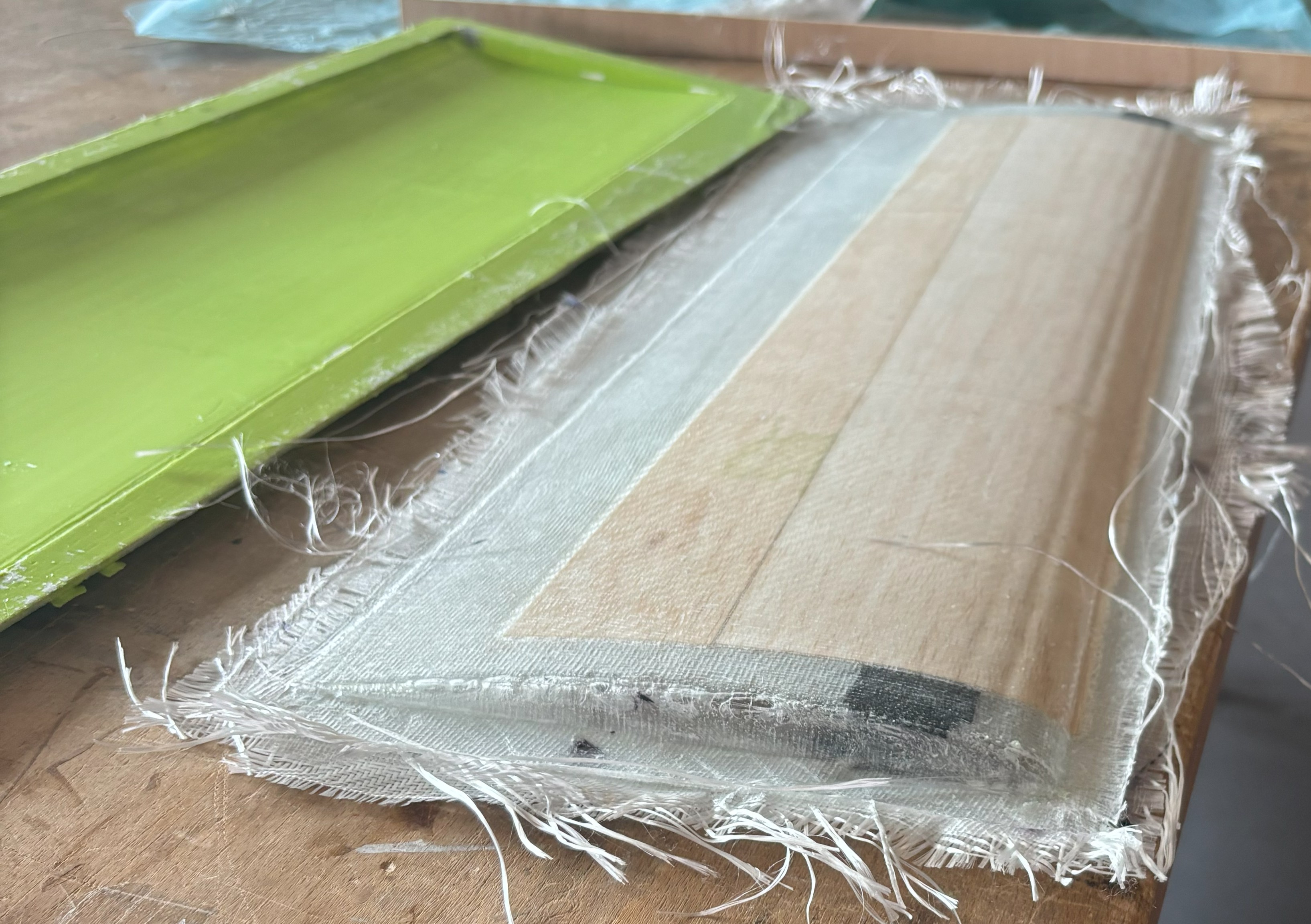
3D printed positive plugs and parting boards generated on Prusa MK4S printers, bonded with CA, then sanded and primed 6–8 times. Coated with PVA release agent, one layer of tooling epoxy gelcoat, and backed by 4 layers of 280 g/m² fiberglass laminate (1.136 m² total mold area).
Skin Production & Infusion
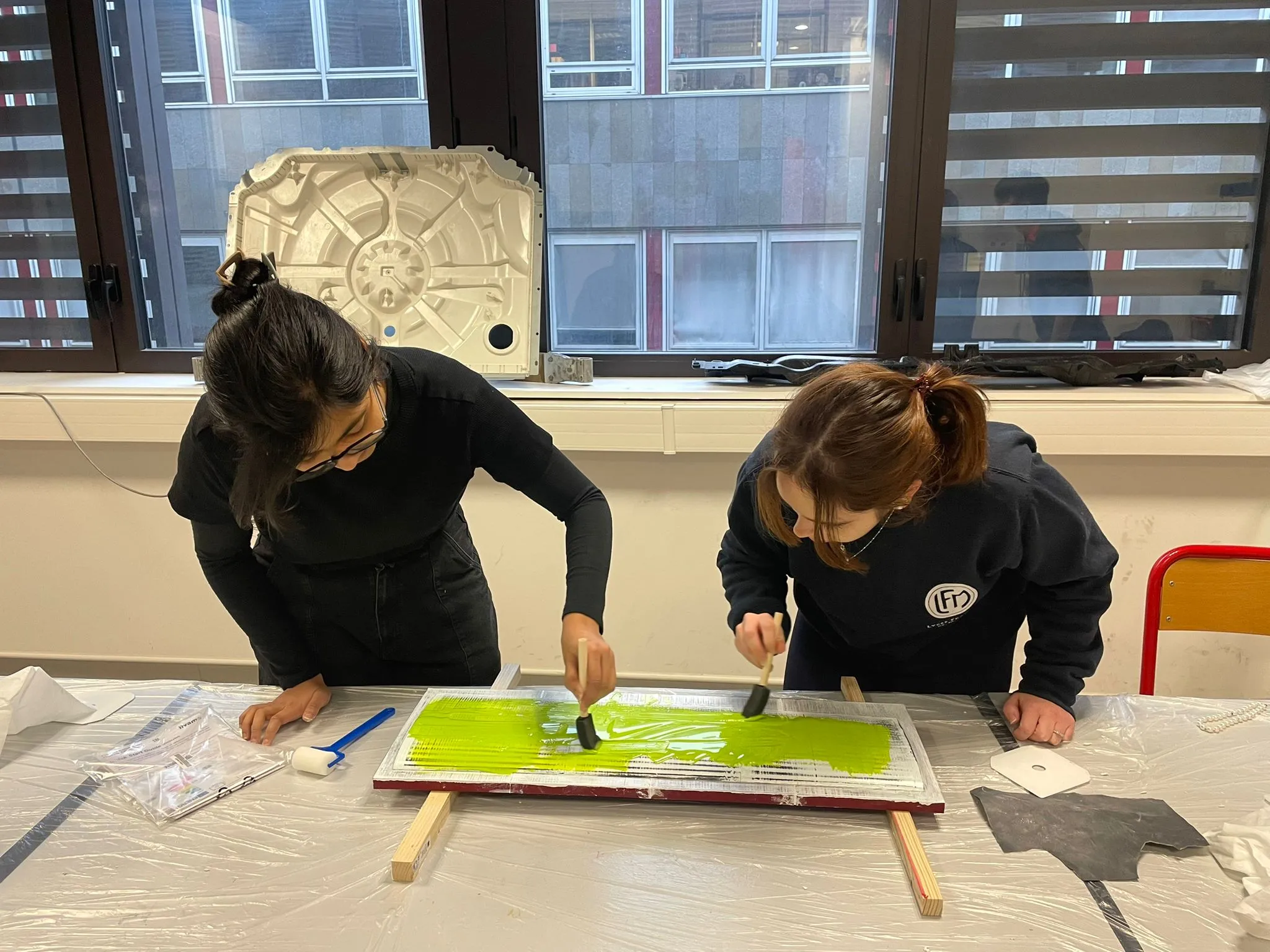
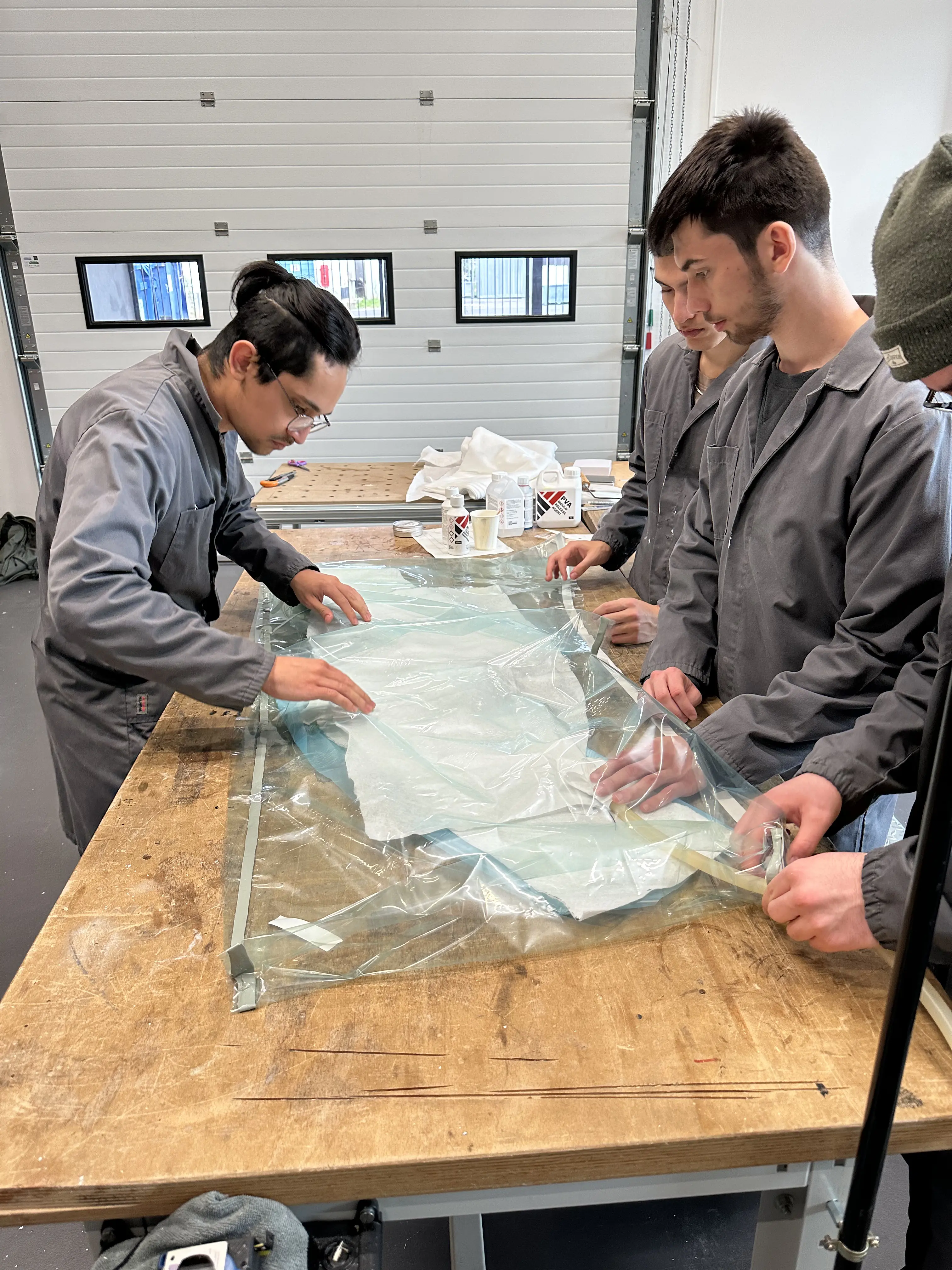
Molds prepped with 4–5 wax coats. Draping 3K 210 g/m² carbon twill, 100 g/m² glass fabric, and unidirectional carbon tape along high-stress bending paths. Cured under vacuum bag with peel ply and breather cloth for 18–24 hours, followed by diamond disc flange trimming.
Internals & 'Kitchen Sink' Bonding
Laser-cut 2.5 mm and 5 mm birch plywood ribs, formers, and shear webs bonded into the bottom skin shell using in-house developed "Kitchen Sink" adhesive—a high-strength, sandable, and inexpensive mixture of epoxy resin, shredded carbon fibers, and glass microballoons.
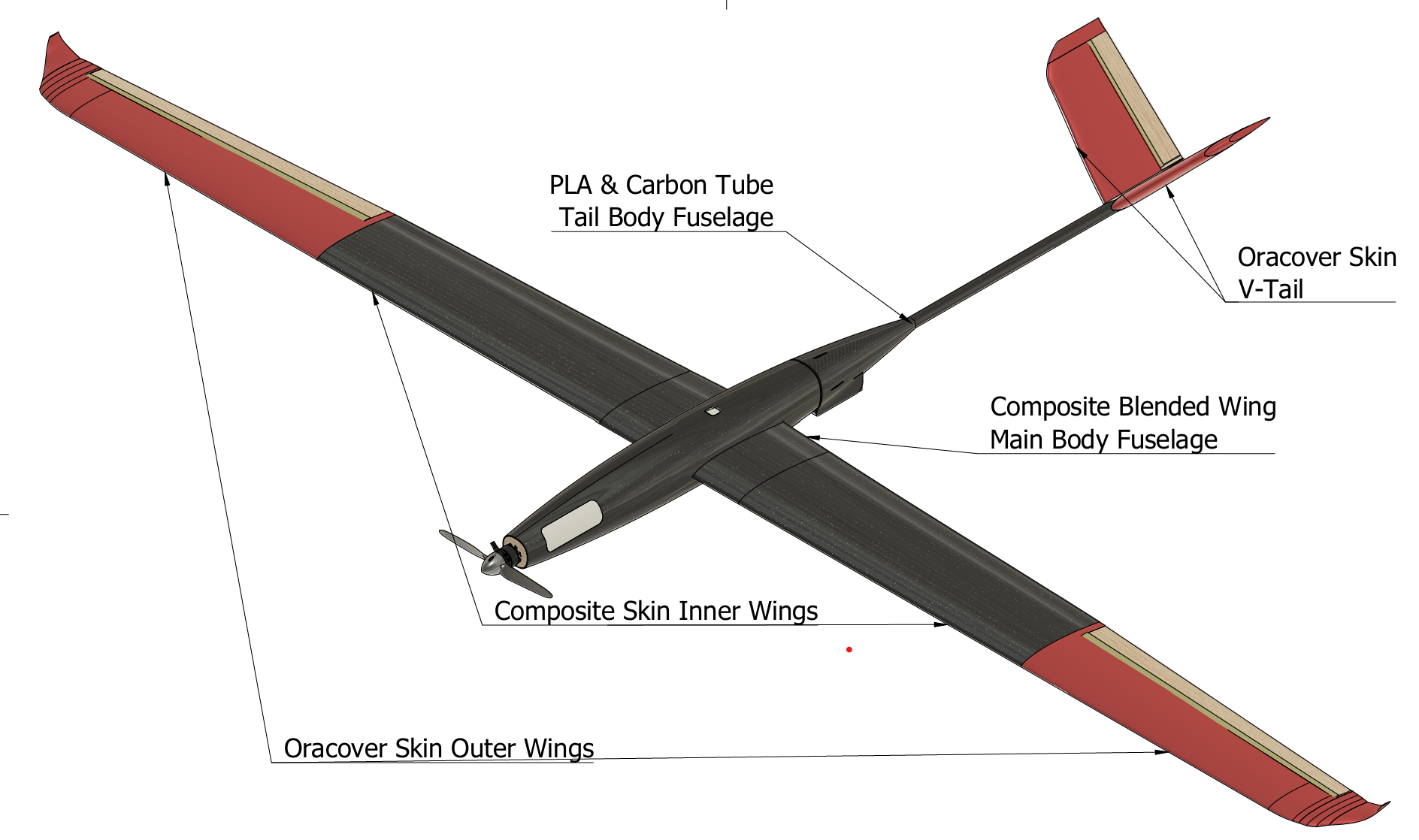
Genuine 2025 Exploded CAD Architectures
Interactive detailed mechanical models extracted from Section 6 of the certified Technical Report
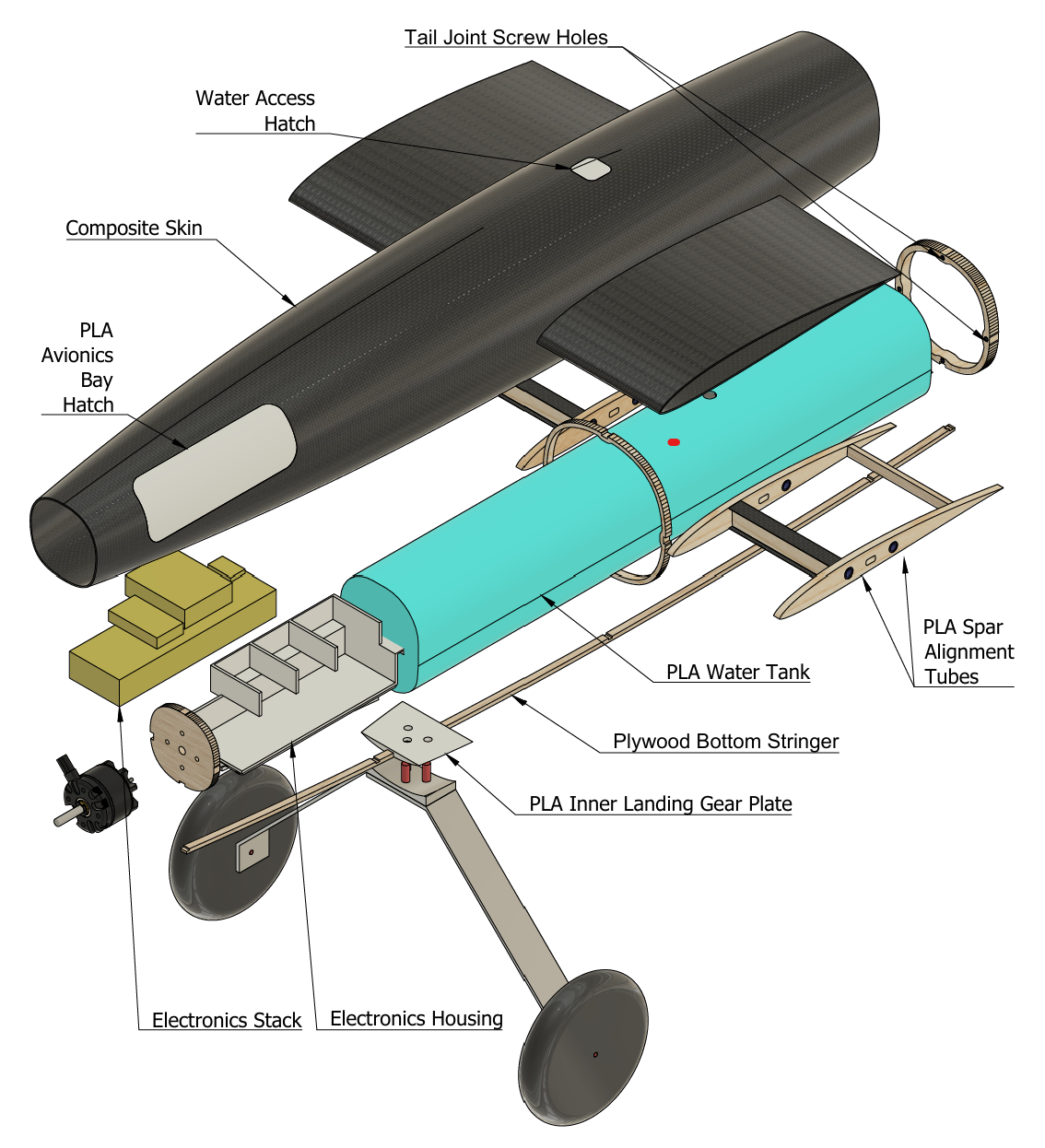
Main Fuselage
2-half composite shell with unidirectional carbon spine reinforcements.
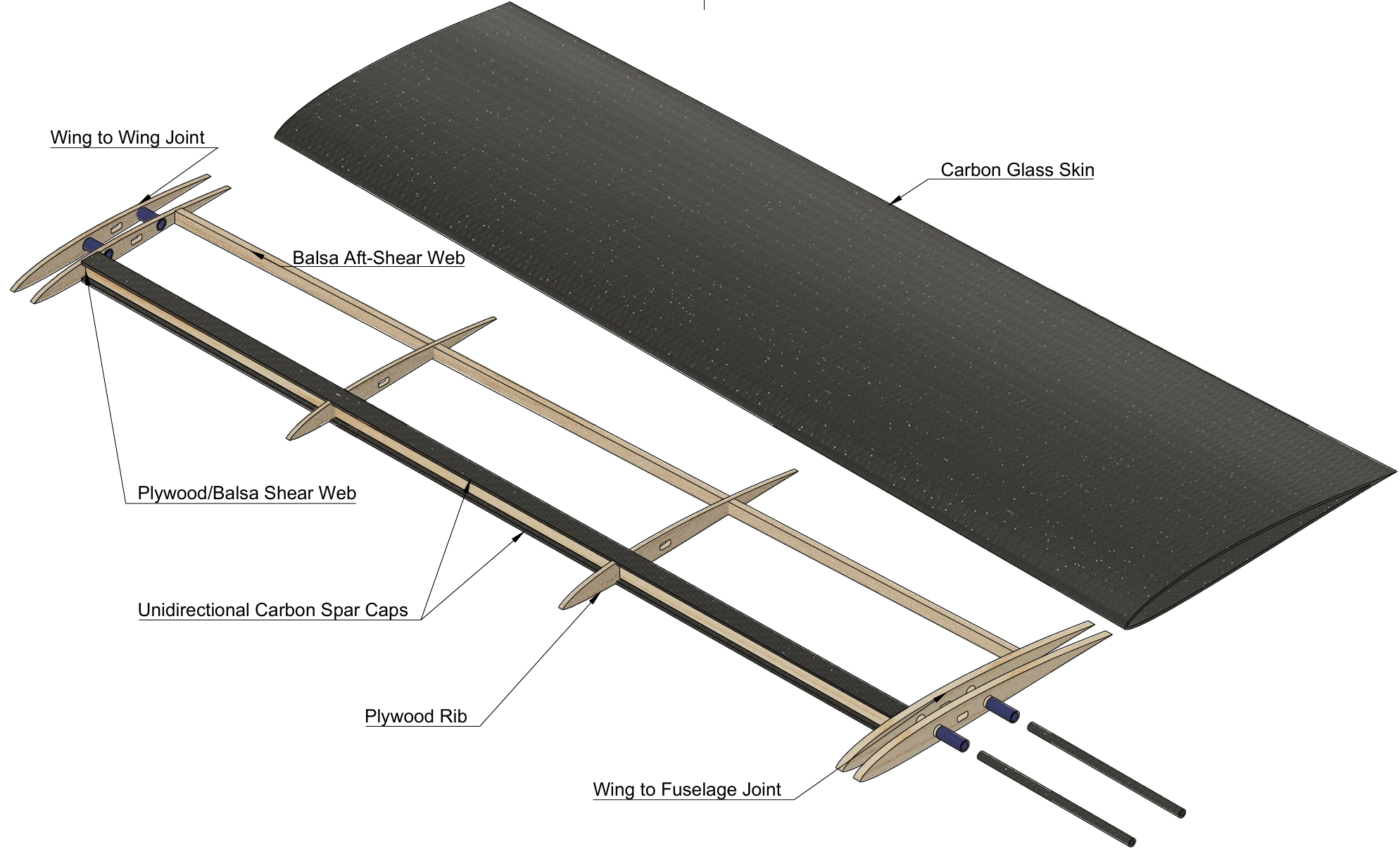
Inboard Wings
Sandwich skin carrying main bending loads into fuselage bulkheads.
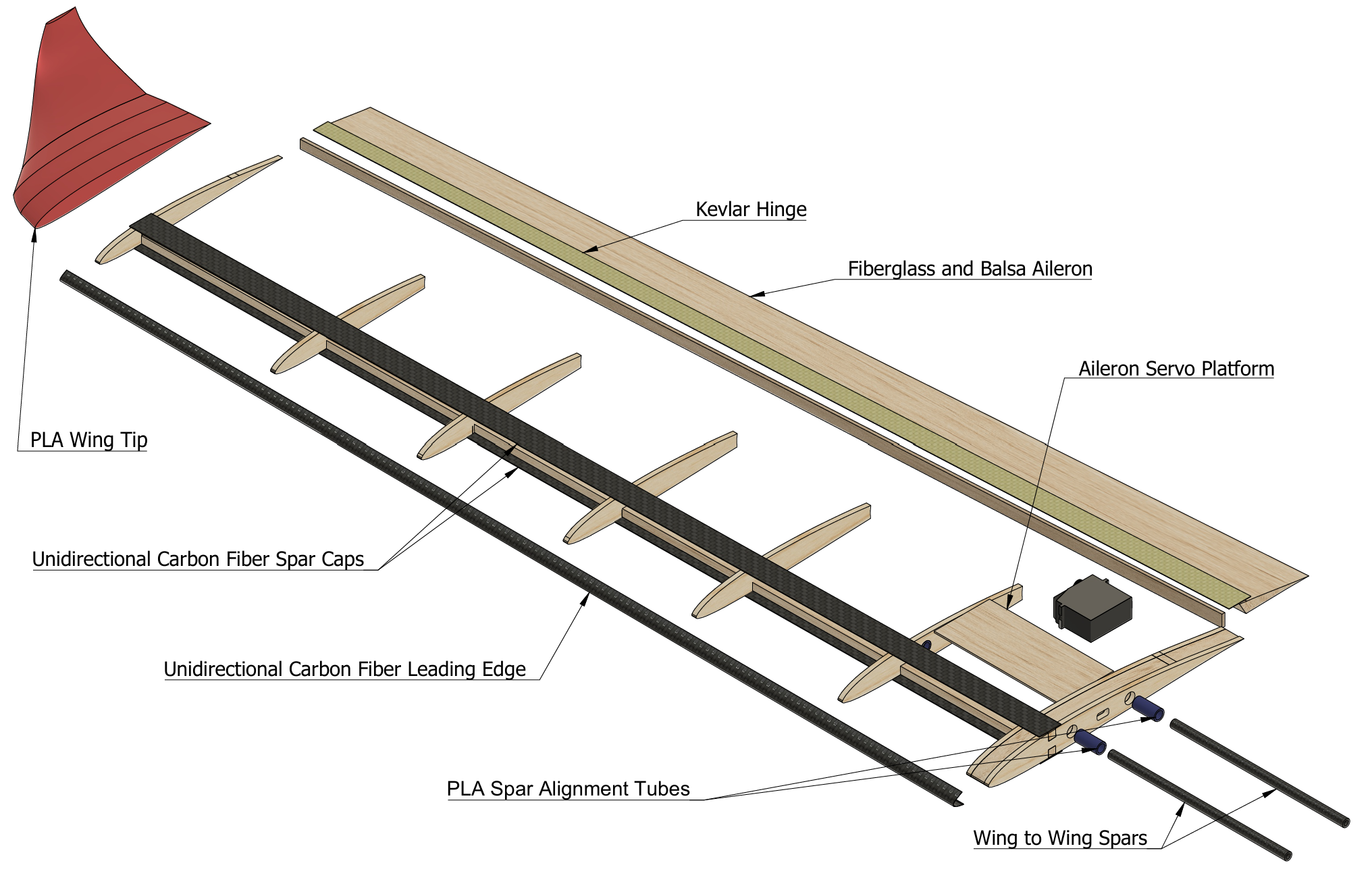
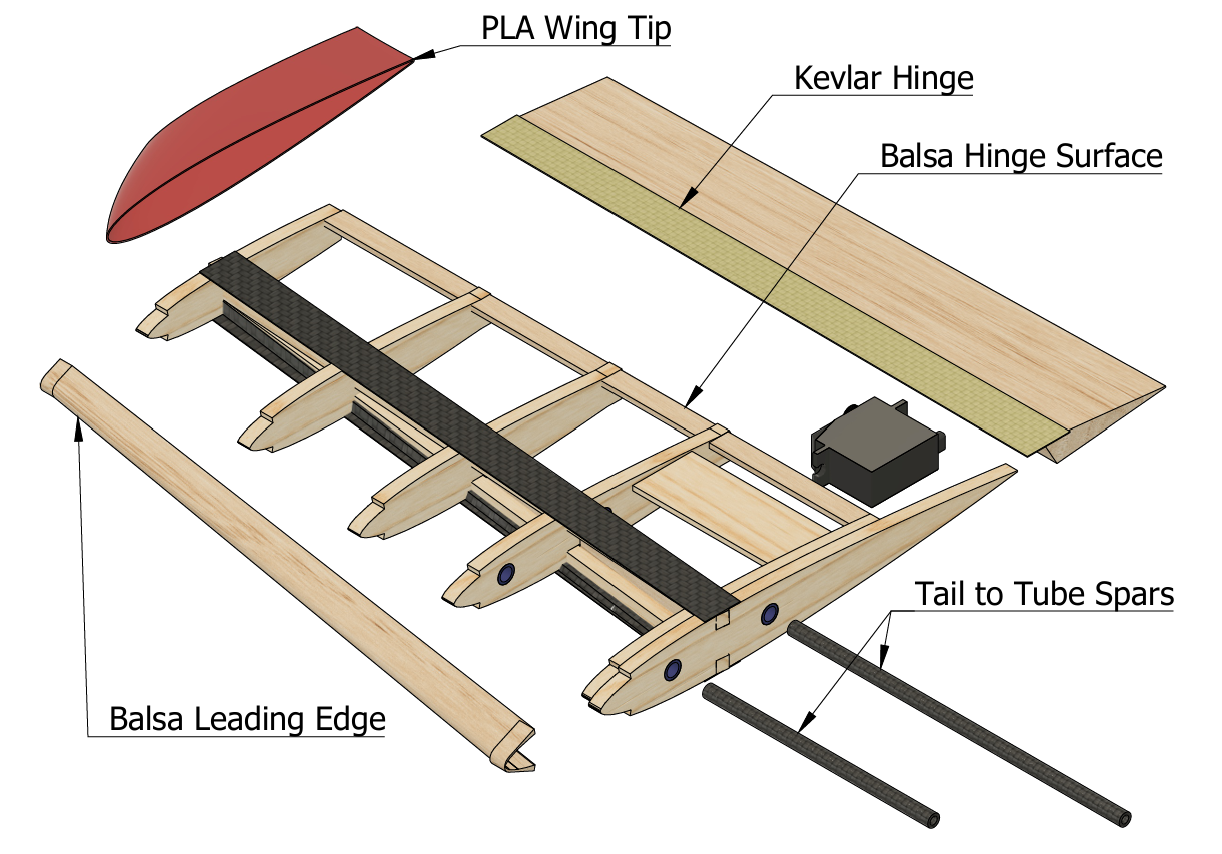
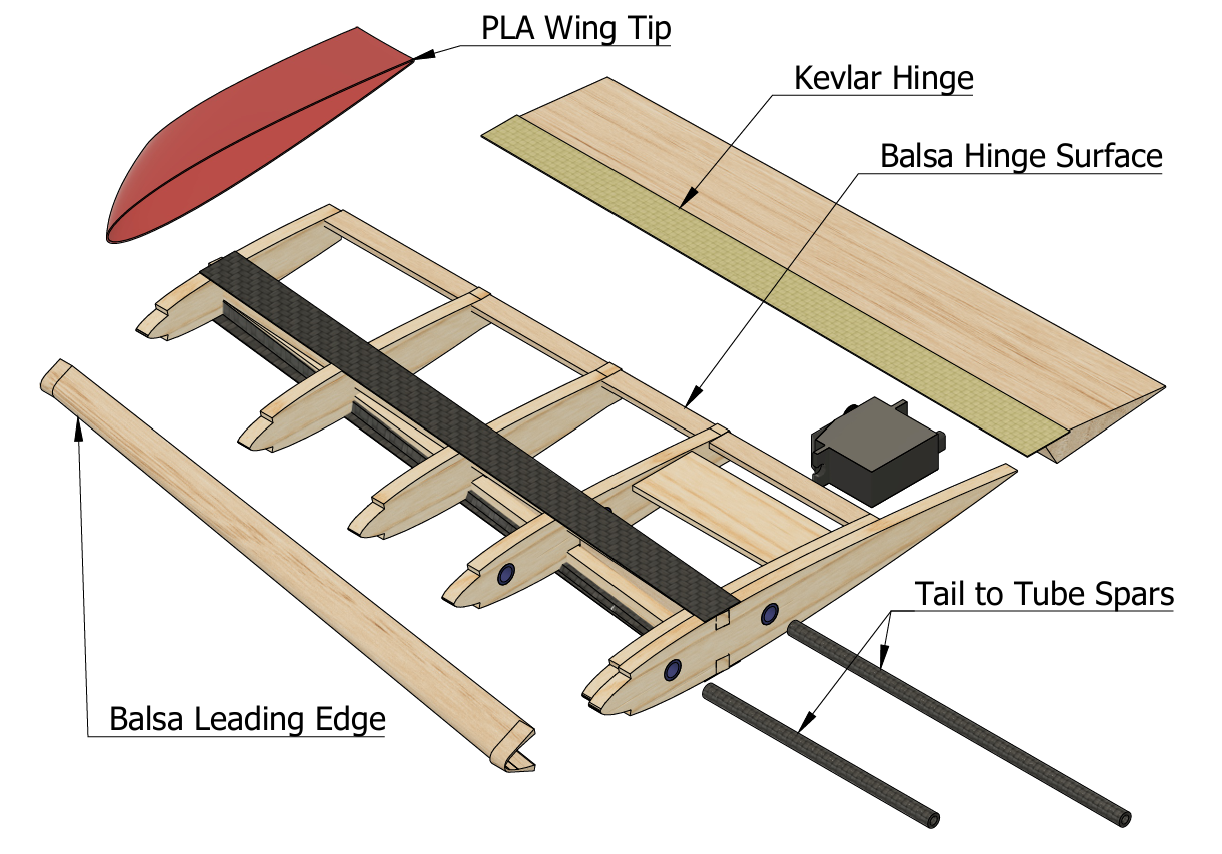
Outboard Wings
Plywood skeleton with carbon spar caps, Oracover skin, and root servo bay.
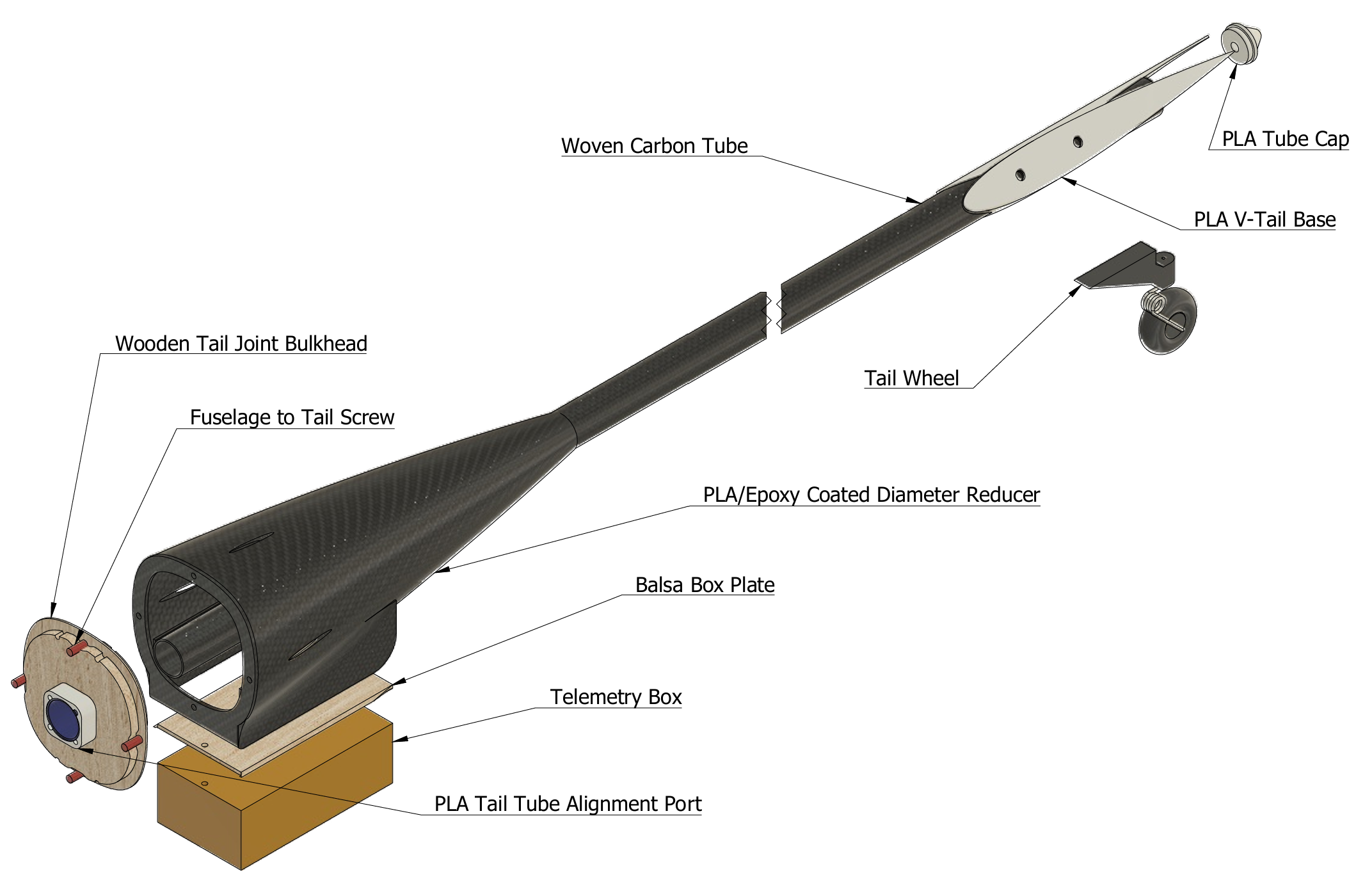
Tail Boom & Junction
Woven Ø20mm carbon tube socket housing elevator pushrods and wiring.
45° V-Tail Half
Symmetrical NACA 0012 surfaces mounted on 3D printed sleeve adapter.
Static Bending Validation Test (Report Section 6.4)
Experimental load-deflection verification up to 5.0 kg per wingtip (10 kg total)
To experimentally validate the flexural stiffness of the joined composite inner and outer wing panels, incremental point loads ranging from 1.0 kg to 5.0 kg were applied symmetrically at each wingtip in 0.5 kg steps while the root was clamped horizontally.
Deflection followed a strictly linear slope up to 5 kg/tip with complete spring-back and zero residual strain.
Acoustic and optical inspection confirmed zero fiber micro-buckling or skin-to-spar debonding.
2.0L Watertight Cargo System & Competition Flight Circuit
2.0L Anti-Slosh Watertight Water Tank
2.0 kg PayloadCarrying 2.0 kg of liquid cargo presents dynamic sloshing hazards that can severely destabilize pitch and yaw trim. ECTanker mitigates this through two key design innovations:
- Zero Pitch Shift: The tank is positioned precisely at the aircraft's Center of Gravity (xCG = 39 mm), guaranteeing zero trim moment shift between full and empty conditions.
- 3D-Printed Anti-Slosh Baffles: Internal perforated bulkheads suppress free-surface wave resonance and lateral momentum transfer during 60° banked pylon turns.
- 30-Second Quick-Fill Funnel: Top fuselage gravity-feed port allows full 2.0 L payload replenishment under 30 seconds on the tarmac flight line.
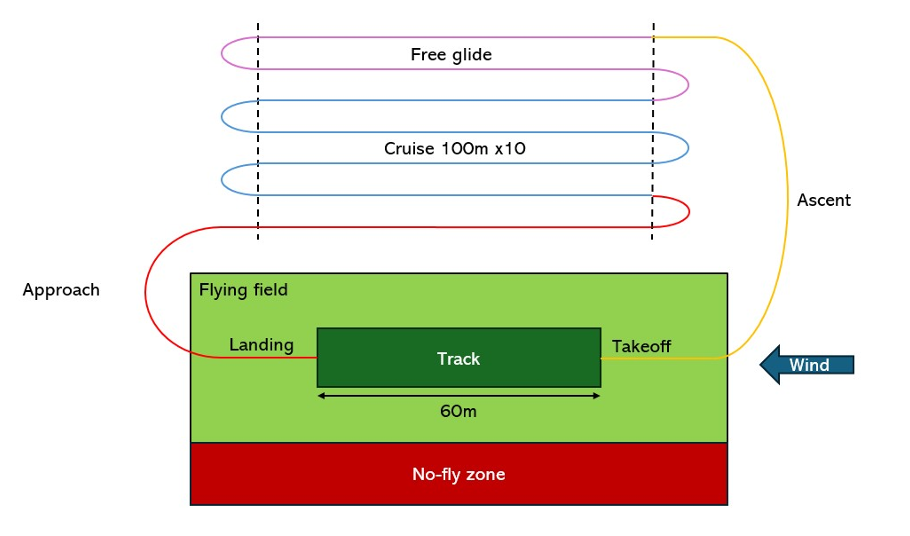
Flight Strategy & Competition Circuit
Valencia UPV AirfieldThe official flight profile in Valencia enforces a strict sequence optimized for scoring points across climb, glide, and circuit speed:
Propulsion Test Bench, Propeller Selection & Avionics
Propeller Matching & Test Stand Calibration
APC 10x6E SelectedThe competition strictly imposed the Emax GT2820/06 985KV motor and permitted selection from 4 propellers (APC 10x6E fixed, APC 10x6F folding, Aeronaut CamCarbon Light 10x6 fixed, Aeronaut CAM Z carbon 10x6 folding). Sizing was verified theoretically via MotoCalc and experimentally calibrated on an in-house static thrust stand with an S-type load cell.
Experimental run-up at 100% throttle (1,137 g theoretical estimate).
Fixed prop avoided folding hub slop, saved weight, cost only €2.00, with <3% efficiency delta.
Sized for 320 seconds total flight window with 20% safety reserve using a Generic 3S 3200 mAh 20C LiPo pack.
Avionics Suite & Dual-Rail Power Bus
Total: €126.77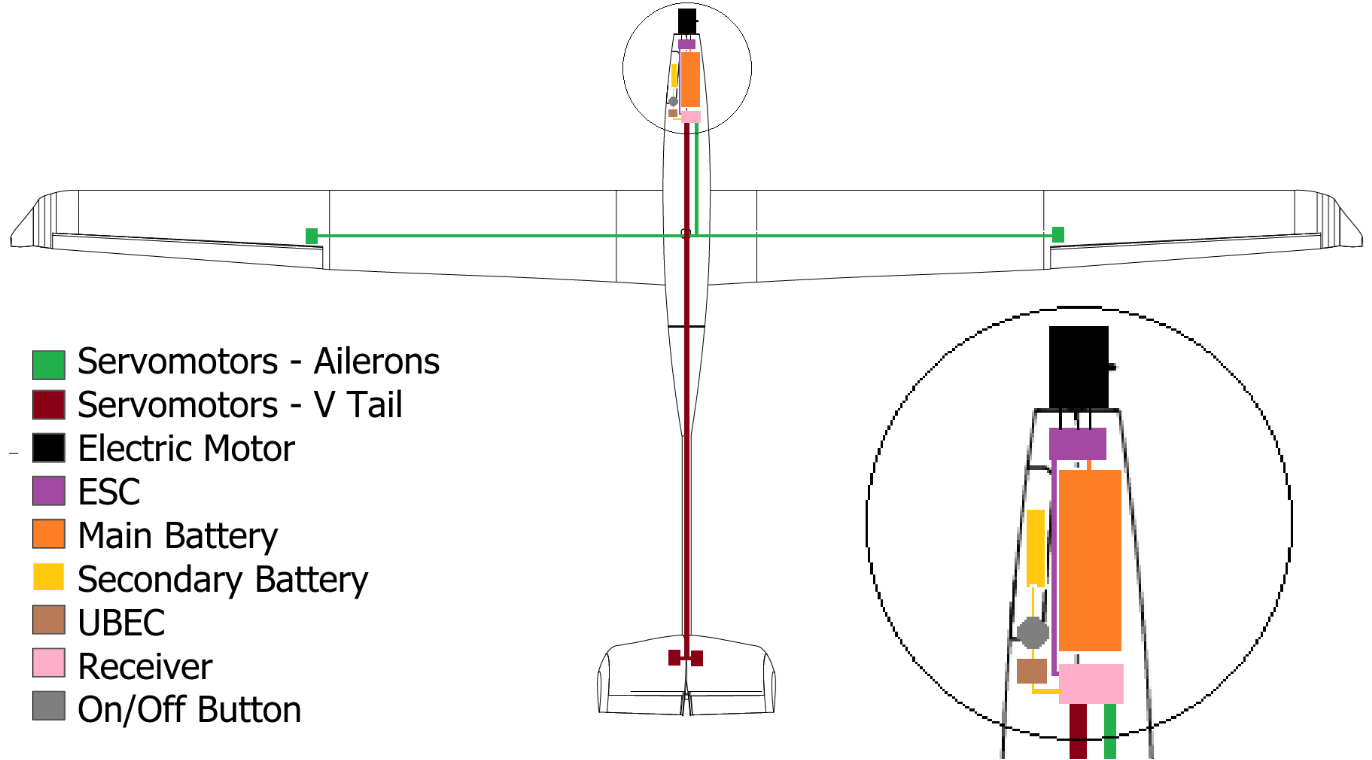
Certified Performance Polars & MATLAB Flight Envelope
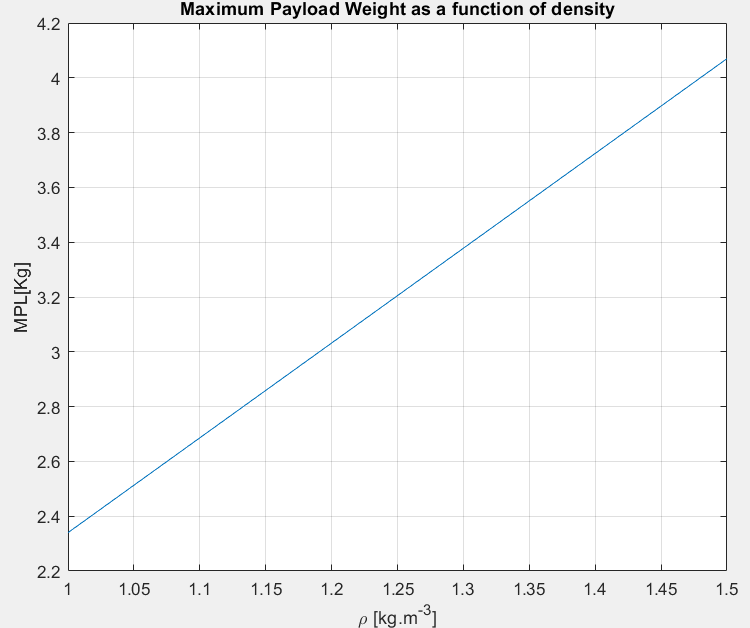
XFLR5 Drag Polar & Take-Off Dynamics
ρ = 1.18 kg/m³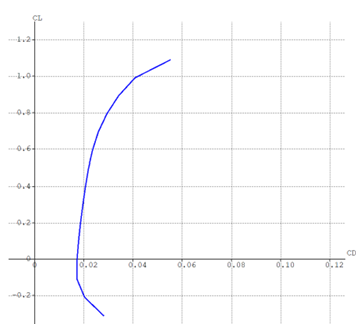
MATLAB V-n Flight Envelope
n_max = +3.5 g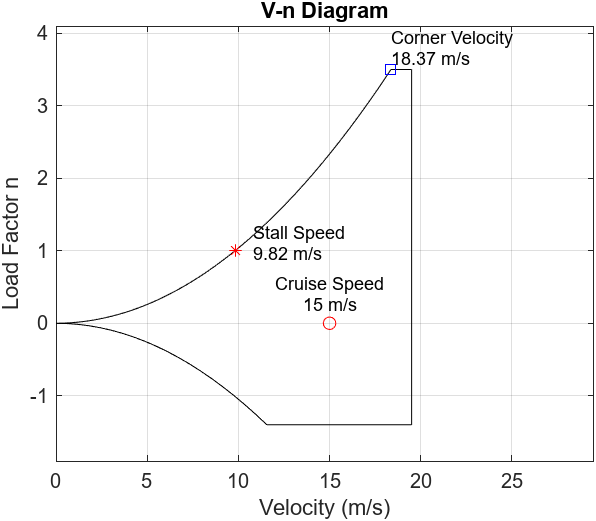
Official Bill of Materials & Regulatory Cost Compliance
In accordance with the XtraChallenge 2025 competition regulations, collegiate prototypes must respect a strict cost ceiling under €400.00 for the aircraft airframe and propulsion system. The complete certified financial breakdown confirms a grand total aircraft cost of €395.61, perfectly complying with all tournament requirements.
Team 2025 Organization, Gantt Timeline & Academic Partners
Organizational Hierarchy (Report Figure 1)
4 Divisions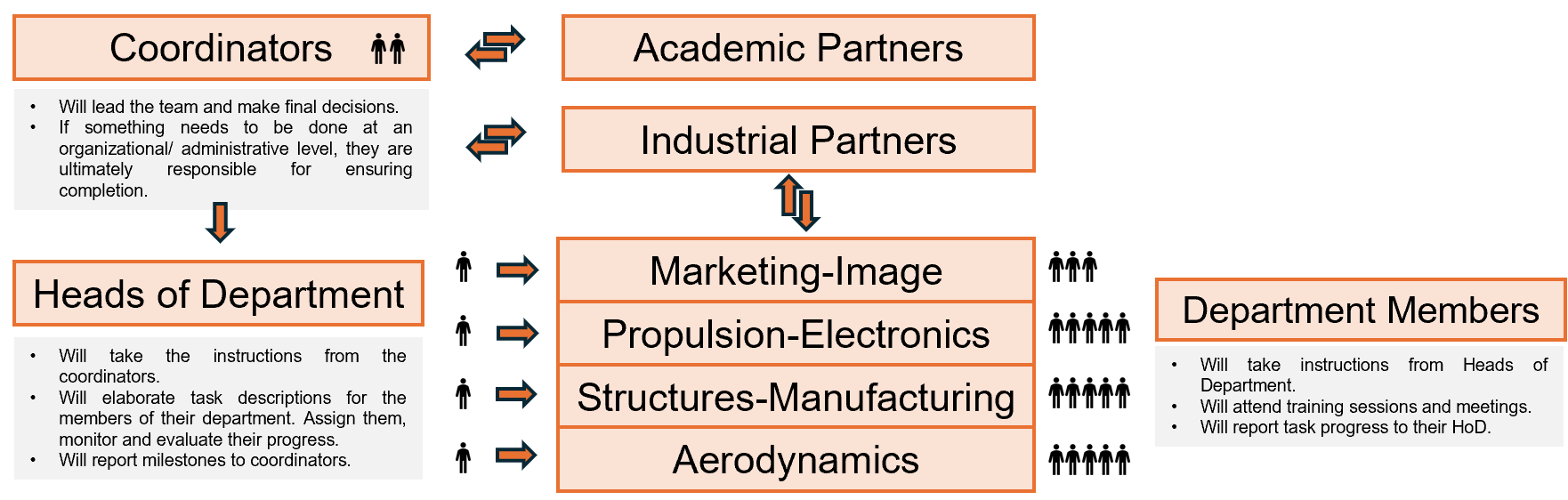
Structures Graphic Timeline & Gantt (Report Figure 2)
August 2024 – July 2025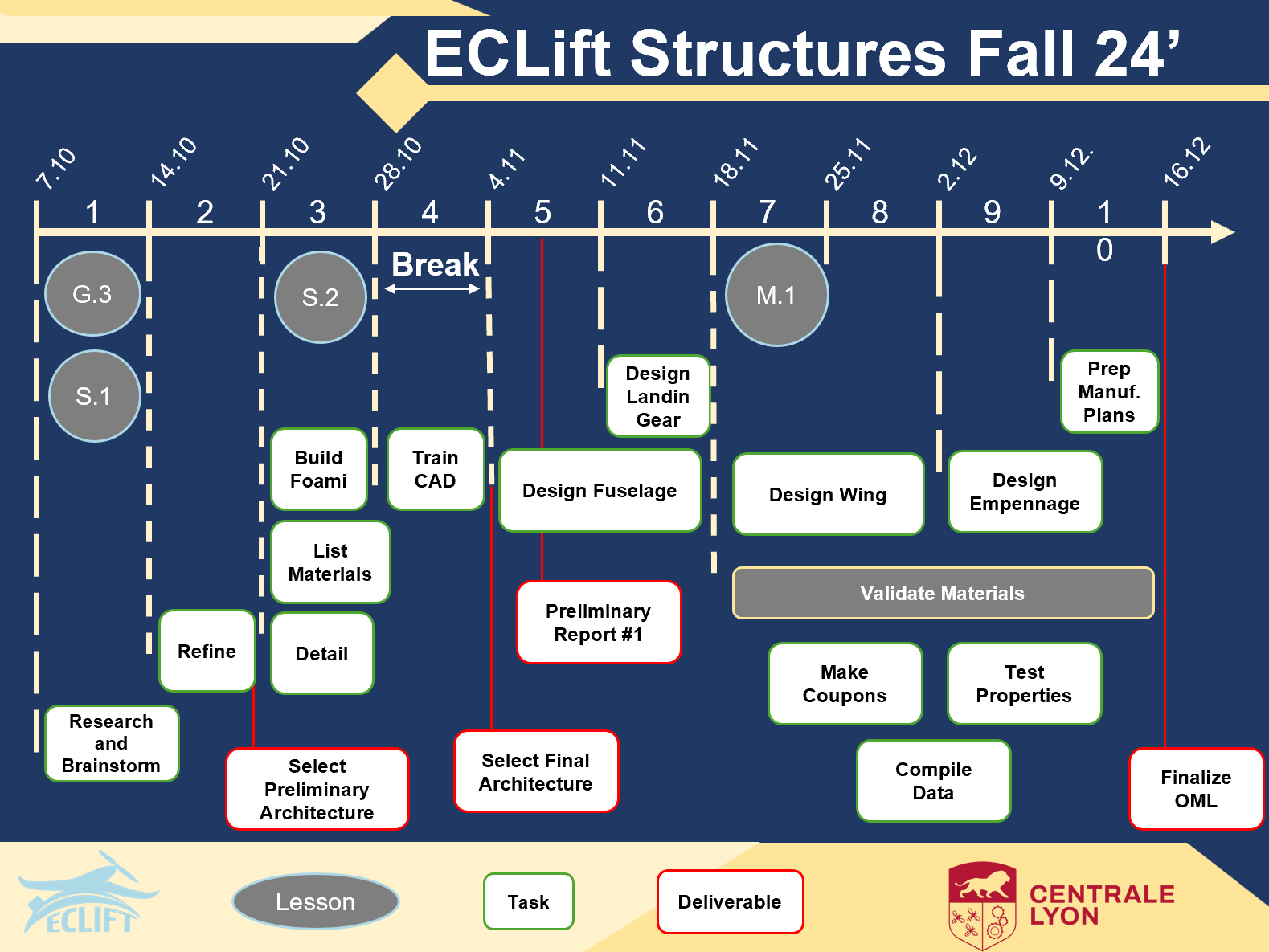
Design & CFD Studies
MH-32 laminar selection, ANSYS Fluent 3D viscous simulations, sharklet optimization, and XFLR5 stability derivatives.
Composites & Manufacturing
3D-printed tooling molds, vacuum-bagged carbon/epoxy layups, static bending test bench, and boxed modular breakdown.
Powertrain & Avionics
In-house load-cell thrust bench calibration, 1,079 g APC 10x6E validation, isolated 2S UBEC rail, and metal-gear servos.
Sponsors & Outreach
Academic backing from École Centrale de Lyon, technical mentoring from LTDS (CNRS), Centrale Innovation, and Thales Group.
Certified Competition Reports & Blueprints 2025
Direct access to the complete, certified engineering reports submitted to the international jury of XtraChallenge 2025 in Valencia. Includes aerodynamic polar calculations in XFLR5, ANSYS Fluent finite volume simulations, composite mold tooling dossiers, structural static bending tests, and full Annex blueprints.
ECLifter 26 | Season 2026 (Completed Campaign)
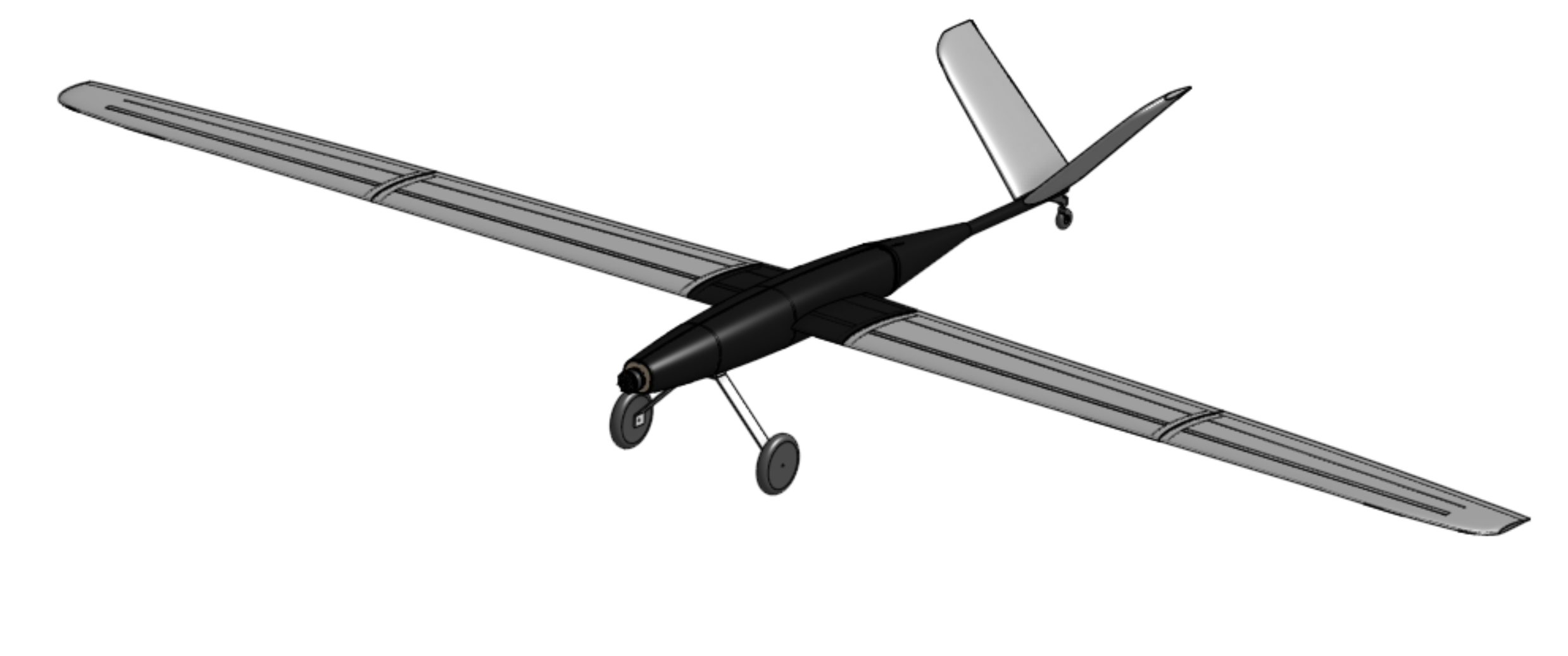
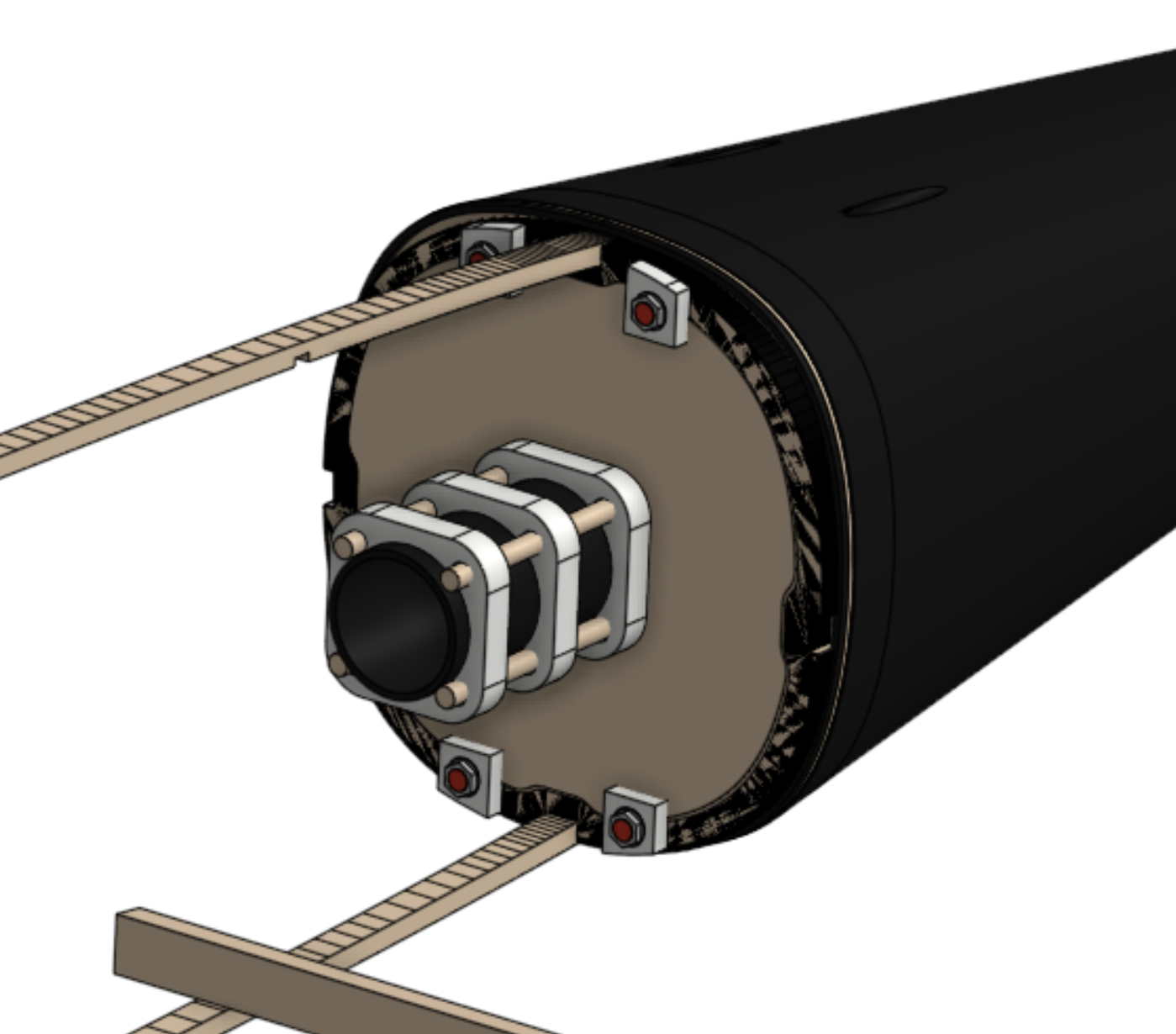
The ECLifter 26 is the competition-certified electric cargo UAV engineered and constructed by 10 student engineers from École Centrale de Lyon for the 4th edition of XtraChallenge in València. Optimized for high aerodynamic efficiency and short takeoff roll (STOL), the airframe features high-aspect-ratio hybrid wings (AR = 8.16, spanwise evolving NACA 6415 / Eppler 66 profiles, vacuum-bagged ±45° carbon fiber skins, laser-cut wood ribs, and UD carbon spar tubes), an all-moving V-tail empennage (V-angle 30°–40°) with NACA 0012 ruddervators, an isolated dual-rail power safety architecture, and an internal wooden exoskeleton carrying a mixed payload of two water packs and one dry grain pack (16 × 12 × 8.5 cm³) directly on the center of gravity.
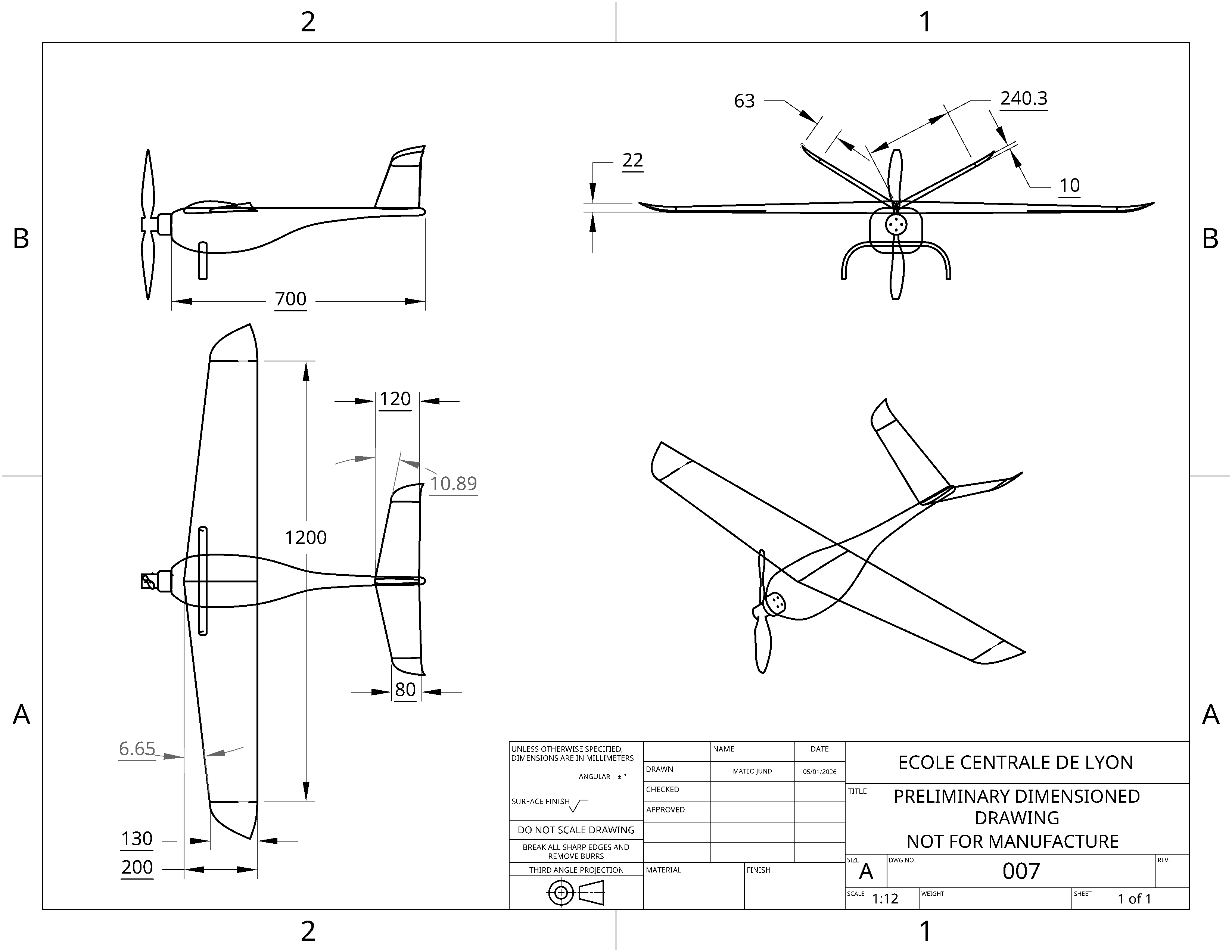
ECLifter 26: Certified 3-View Engineering Blueprints & 3D CAD
Scale 1:12 official dimensioned drawing submitted to XtraChallenge 2026 jury (Drawn by Mateo Jund, 05/01/2026)
Spanwise Evolving Airfoil & Longitudinal/Lateral Stability
Iterative multi-objective aerodynamic optimization at low Reynolds numbers (Re ≈ 200 000)
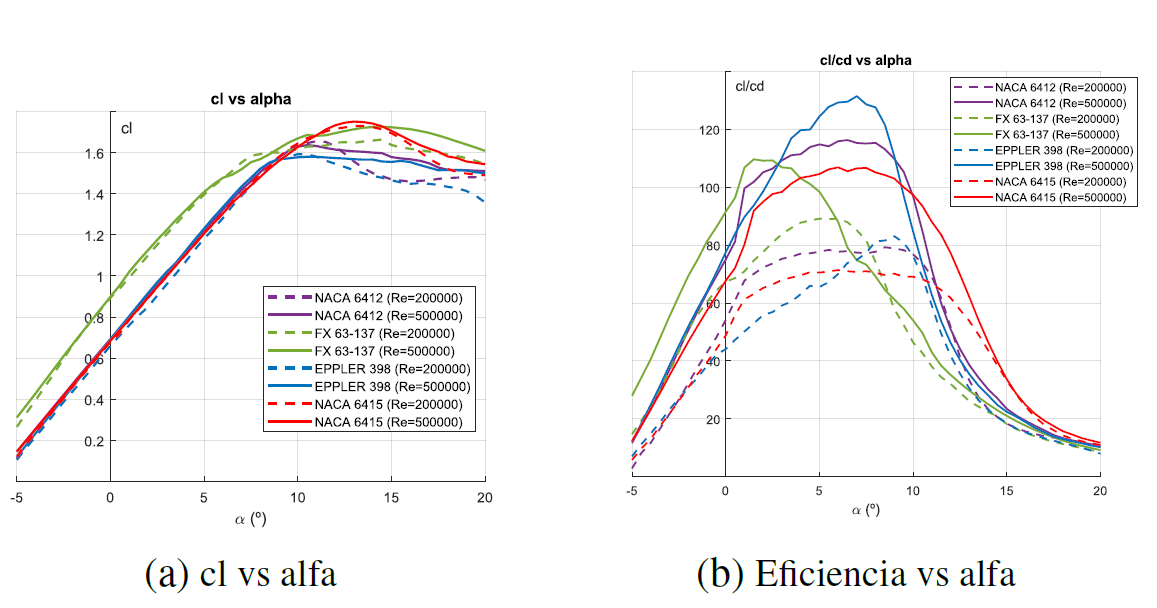
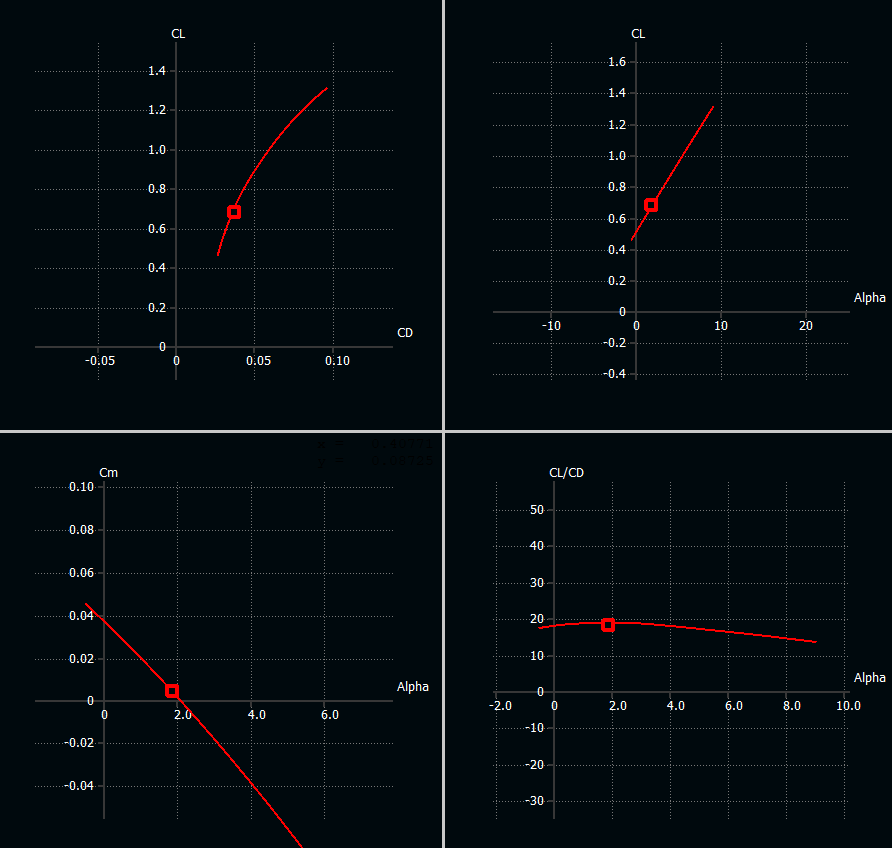
The aerodynamic configuration was synthesized through parametric investigations in XFLR5 at low Reynolds numbers (Re ≈ 2 × 10⁵), representative of RC cargo flight regimes. To combine maximum lifting capability during full-load takeoff with clean low drag in high-speed cruise, a dual-airfoil evolving spanwise layout was selected:
15% relative thickness with pronounced camber, delivering exceptionally high CL,max to carry the 3.0 kg MTOW over short 6.16 m takeoff runs without early stall.
12% thickness profile optimized for low Reynolds drag minimisation, progressive stall margin across the taper, and crisp aileron roll response under lateral gust loading.
| Airfoil | CL,max | Drag Behavior | Low-Re Suitability | Engineering Remarks |
|---|---|---|---|---|
| NACA 6415 | Very High | Moderate | Very Good | Selected for Wing Root (Heavy Lift) |
| Eppler 66 | Moderate–High | Low | Excellent | Selected for Wing Tip (Anti-Stall & Glide) |
| NACA 6412 | High | Moderate | Good | Higher drag at positive angles |
| Eppler 210 | High | Moderate | Good | Balanced polar, lower root moment |
| Eppler 398 | High | Moderate–High | Good | Less efficient at transition |
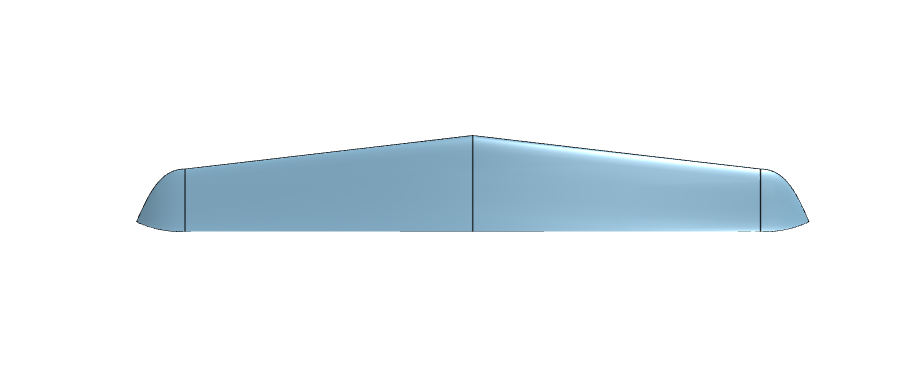
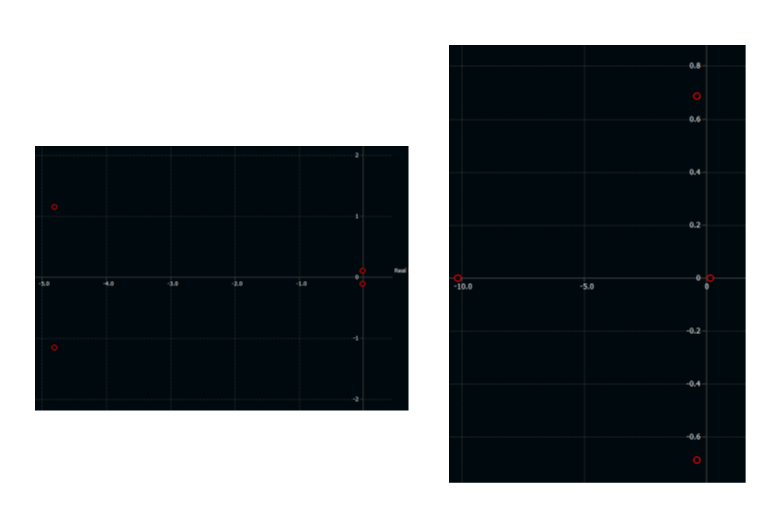
Certified Stability & Control Geometry
Propeller Optimization, ESC Thermal Upgrade & Dual Independent Power Rails
Rigorous 6-propeller trade study, bench test validation, and zero single-point-of-failure avionics
Blade Element Theory & Propeller Sizing
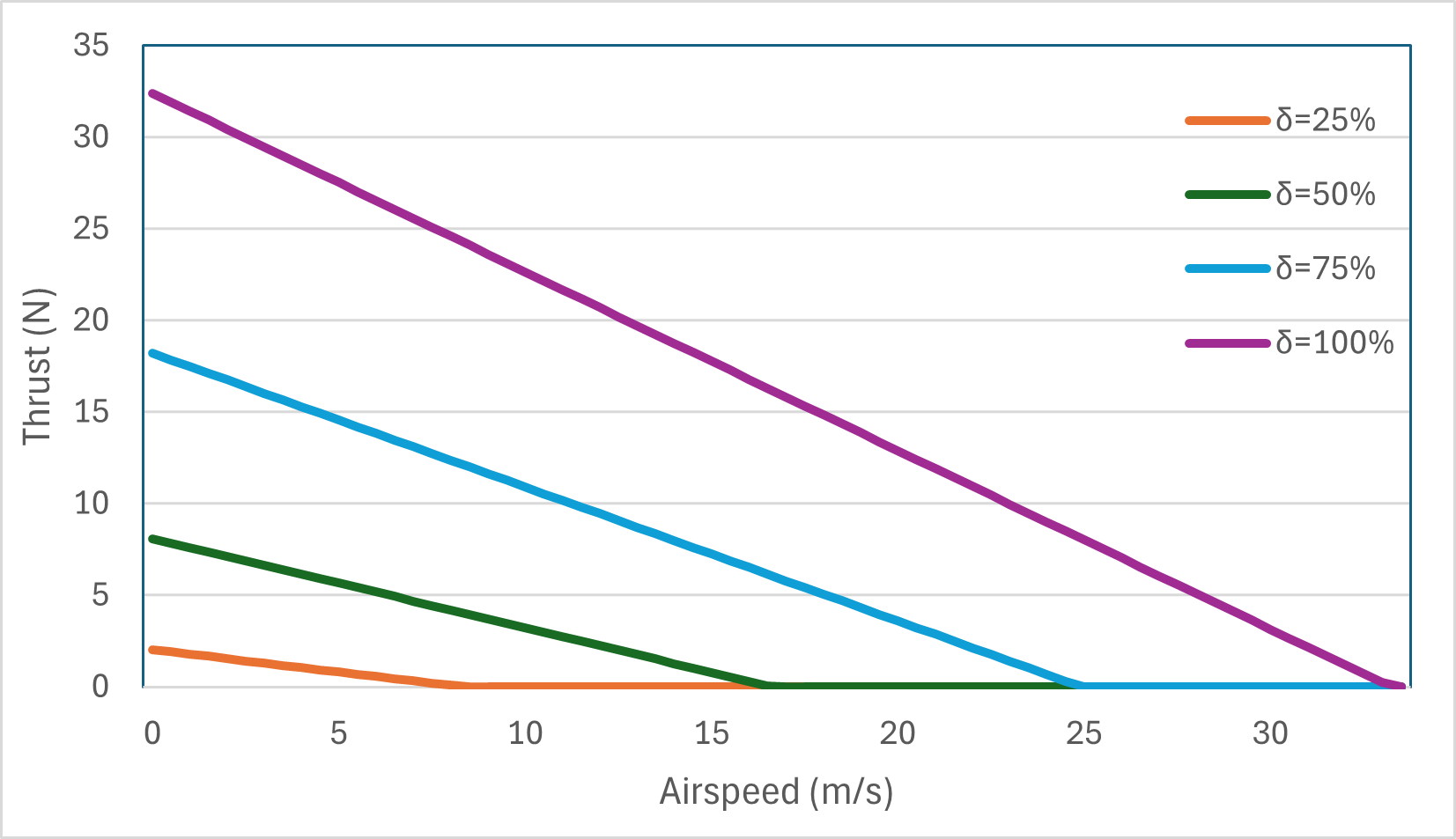
Six candidate propeller configurations were evaluated against two non-negotiable constraints: a static thrust-to-weight ratio T/W ≥ 1.0 and maximum current draw strictly below 48 A for reliable ESC thermal margins. Using blade element theory (P ∝ D⁴ · p) and actuator disk calculations (T = C · (2ρAP²shaft)1/3), the 10×5 propeller was certified as the sole configuration meeting both criteria, operating at an optimal advance ratio of J = 0.771 right in the peak efficiency regime during cruise.
During initial static bench testing with the Emax GT2826/04 motor, a standard 40A ESC suffered thermal failure despite continuous draw remaining within 40A. The electrical division immediately upgraded the propulsion chain to the Skywalker 60A V2 ESC with integrated heat sink and dedicated air-cooling ducts, ensuring complete thermal safety.
Dual Isolated Power Rail Architecture
To eliminate single points of failure, the avionics architecture features two 100% physically isolated power lines. In the event of a catastrophic motor short or total depletion of the main propulsion battery, flight controls remain fully powered:

Main: Tattu 4S 2300mAh 75C (Max continuous 172.5 A ≫ 24.35 A). Secondary: Tattu 2S 650mAh 95C through 40A fuse switch & 5A UBEC (4 servos draw 0.72 A under flight load).
Internal Layout, Mixed Cargo Container & Ashby Material Methodology
Longitudinal mass distribution, vibration-damped cargo bay, and Ashby multi-criteria decision method (MCDM)
Longitudinal Layout & CG Preservation
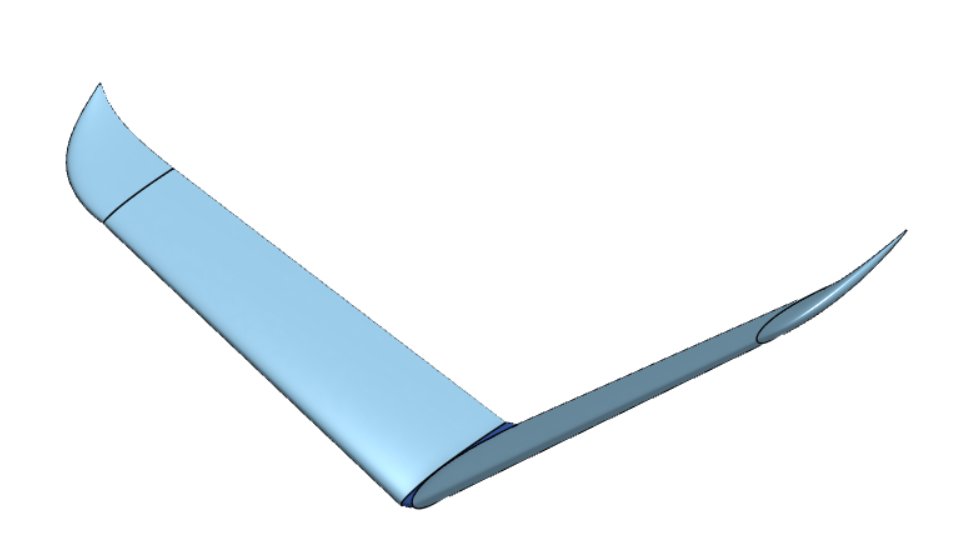
The fuselage adopts an oval cross-section with a slightly squared central section, engineered taller than it is wide to maximize vertical payload clearance while maintaining a tight frontal aerodynamic cross-section. The internal components are distributed along the longitudinal axis:
The payload comprises two watertight liquid packs and one dry rice pack housed in a standardized container. The compartment is positioned exactly over the aerodynamic center of gravity so varying cargo loads do not disturb longitudinal trim. All surrounding empty spaces are backfilled with precision-cut hard foam, eliminating cargo sloshing, dampening motor vibrations, and providing internal shear reinforcement.
Ashby Methodology & Hybrid Materials (Table 12)
Materials selection was executed through a three-stage methodology: Ashby chart property screening (E ≥ 30 GPa, ρ ≤ 3000 kg/m³), the Performance Index method for bending-critical beams (M = √E / ρ), and a Multi-Criteria Decision Method (MCDM) balancing stiffness, weight, fabrication speed, and cost:
| Airframe Subsystem | Selected Material | Structural Role & Function |
|---|---|---|
| Wing Skins | Plain-weave CFRP (±45°) | Aerodynamic shape & high torsional rigidity |
| Wing Spars | UD Carbon tubes/rods | Primary bending moment load path |
| Internal Ribs | Laser-cut lightweight wood | Maintains exact NACA 6415/E66 contours |
| Fuselage Shell | Composite Carbon shell | Rigid external aerodynamic monocoque |
| Fuselage Exoskeleton | Aviation plywood formers | Internal load transfer for cargo & landing gear |
| Tail Boom | Carbon fiber hollow tube | Rigid boom connecting empennage to fuselage |
| Tooling Molds | 3D-printed PLA (Elegoo) | Rapid low-cost master negative tooling |
Composite Tooling, Epoxy Wet Layup & 24h Vacuum Consolidation
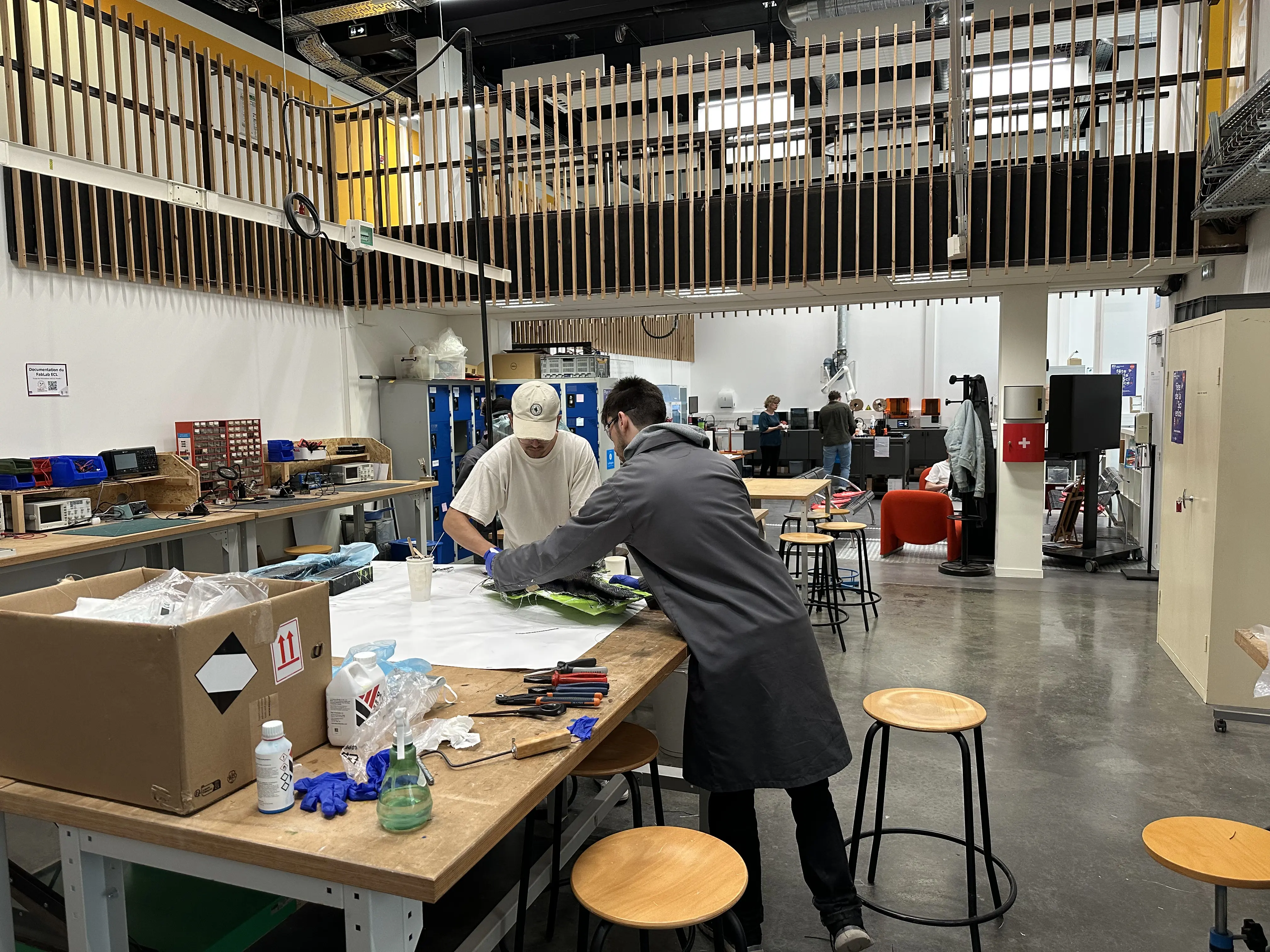
Documented shop floor fabrication steps executed in Centrale Lyon workshops and FabLab
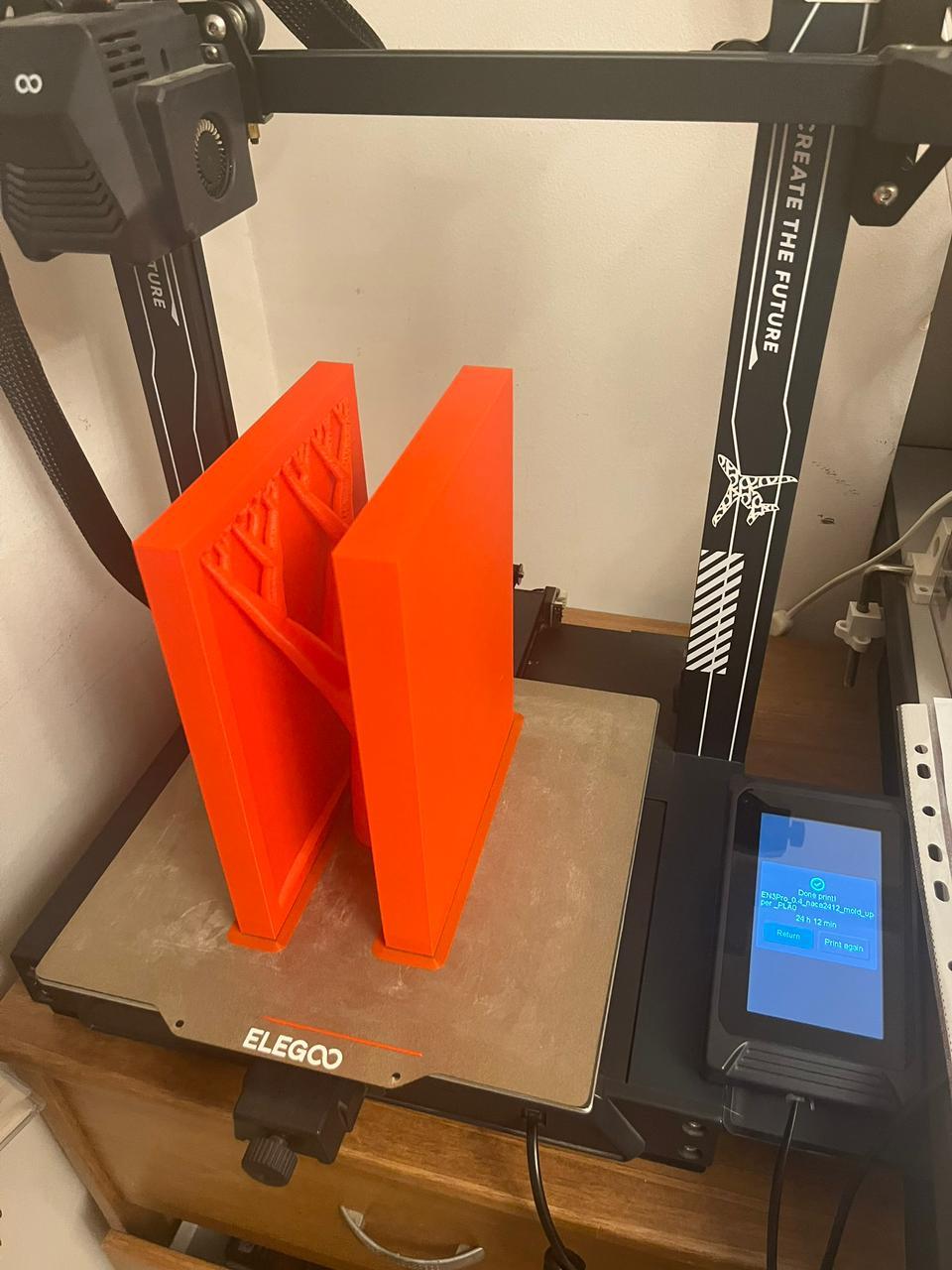
1. 3D Printed Molds
PLA Tooling (Elegoo)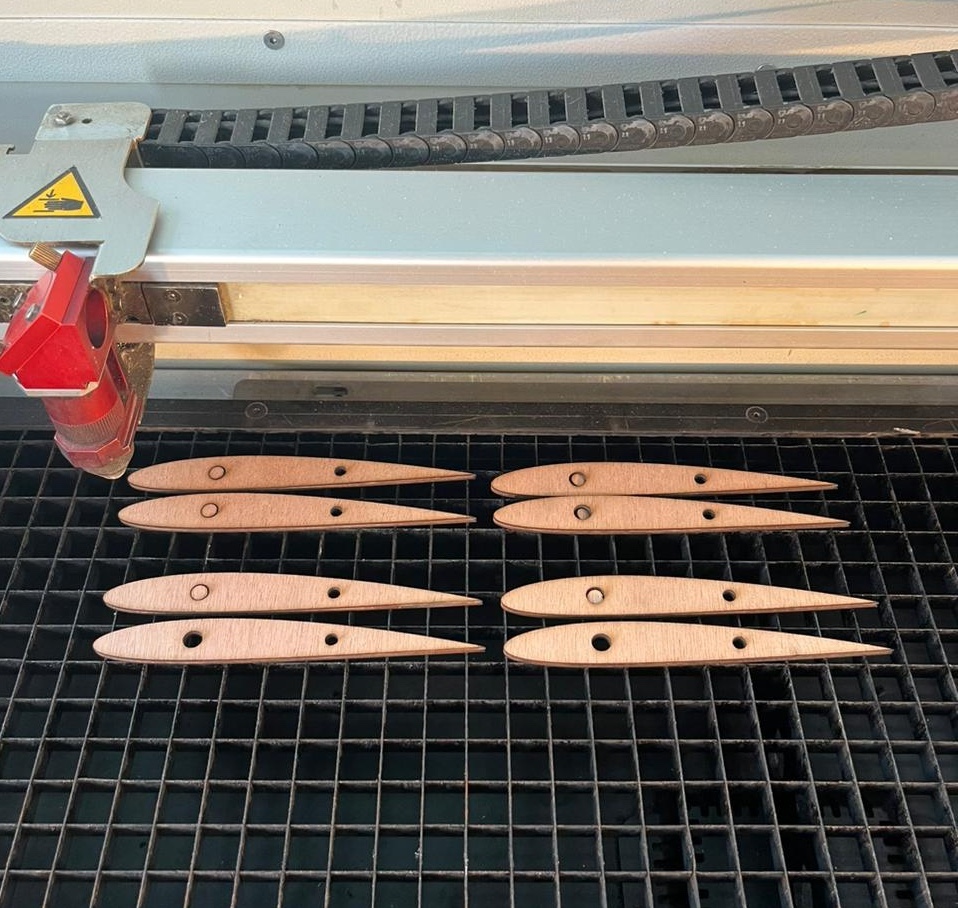
2. Laser Cut Ribs
Centrale FabLab
3. Epoxy Mixing
Ratio 100:27 Mass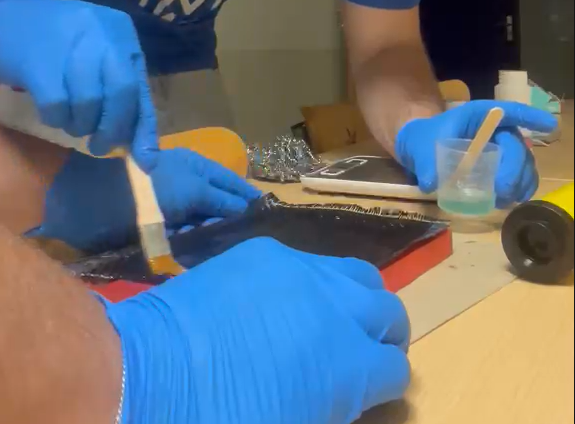
4. Carbon Layup
±45° Dual Plies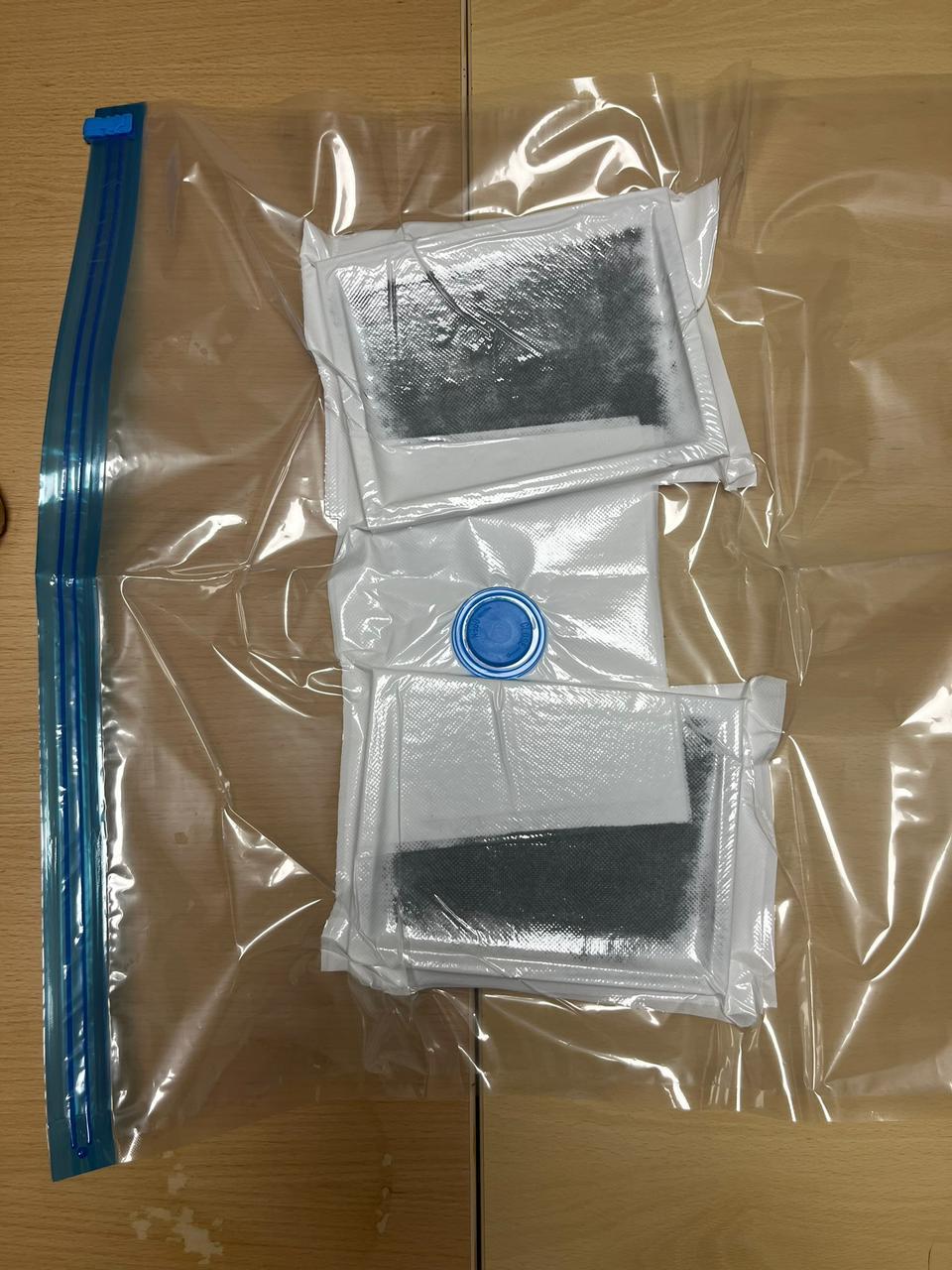
5. Vacuum Cure
24h Pressure Seal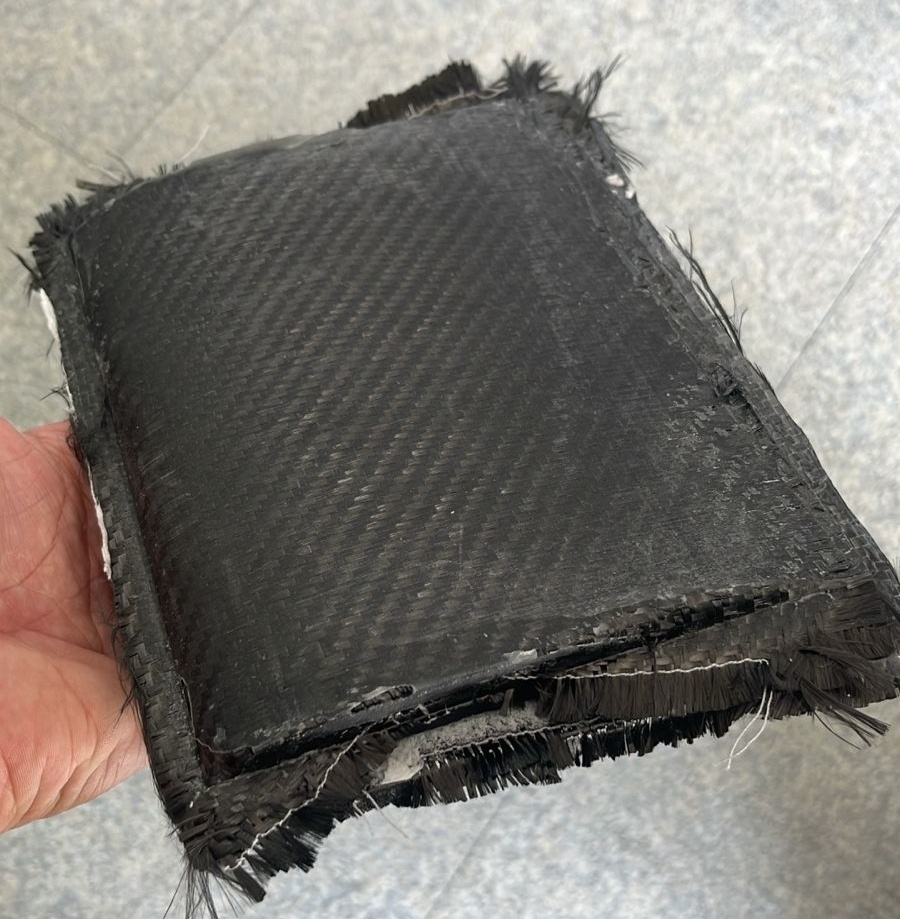
6. Raw Wing Box
Closed Box StructureTechnical Lessons Learnt (Section 11 of Report)
During first vacuum trials, paper used as a substitute protective film partially bonded to the curing laminate. The team concluded that industrial perforated peel ply is mandatory for reliable demolding.
Static test bench burnout of the initial 40A ESC proved the necessity of sizing current limits with at least a 25% continuous buffer and routing cooling airflow over speed controllers.
Aerodynamic multi-airfoil iterations compressed subsequent workshop build schedules, demonstrating the value of parallelizing mold machining while finalizing numerical polars.
Flight Envelope & Short Takeoff (STOL) Performance
All parameters evaluated at certified maximum takeoff weight (MTOW = 3.00 kg)
| Flight Parameter | Mathematical Formulation | Certified Value | Engineering Assessment |
|---|---|---|---|
| Stall Speed (Vs) | √(2W / (ρ · S · CL,max)) | 8.59 m/s | Guarantees safe low-speed landing and unpowered glide control |
| Takeoff Speed (VTO) | 1.2 × Vs | 10.31 m/s | Liftoff safety buffer with zero risk of low-altitude stall |
| Takeoff Distance (STO) | VTO² / (2a) | 6.16 m (≈ 6.2 m) | Exceptional STOL capability under heavy competition payload |
| Cruise Speed (V) | √(2W / (ρ · S · CL)) | 12.65 m/s (45.5 km/h) | Optimal advance ratio (J = 0.771) with minimum electrical drain |
| Maximum Speed (Vmax) | V · (Pavail / Preq)1/3 | 16.45 m/s (59.2 km/h) | High-speed dash capability for urgent delivery mission windows |
| Rate of Climb (ROC) | (Pavail - Preq) / W | 10.20 m/s | High excess power enabling rapid obstacle and turn climbouts |
| Thrust-to-Weight Ratio (T/W) | Tavail / W | 0.88 | Robust powertrain sizing with 10×5 propeller |
| Flight Endurance (t) | E / Preq | 17.8 min | Long cruise window under nominal 4S LiPo capacity |
| Total Range | V × t | 13.5 km (13 485 m) | Long-distance transit capability over extended circuit legs |
Official Bill of Materials & Regulatory Cost Compliance (< €400)
Certified financial audit submitted to XtraChallenge 2026 jury with complete itemized receipts
In accordance with XtraChallenge 2026 tournament regulations, collegiate prototypes must respect a strict cost ceiling of approximately €400.00 across electronics, propulsion, and raw fabrication materials. The verified financial breakdown confirms an optimized grand total of €403.00, maintaining high safety factors while fulfilling tournament rules.
Table 16: Electronics & Propulsion
Subtotal: €247.00| Component | Qty | Cost [EUR] |
|---|---|---|
| Emax GT2826/04 1090KV brushless motor | 1 | €43.00 |
| Tattu 2300mAh 4S 75C LiPo main battery | 1 | €36.00 |
| Tattu 650mAh 2S HV secondary battery | 1 | €11.00 |
| Skywalker 60A V2 electronic speed controller | 1 | €25.00 |
| FlySky FS-i6 radio + FS-IA6B receiver set | 1 | €55.00 |
| EMAX high-torque servos (flight surfaces + spares) | 6 | €48.00 |
| UBEC 5A voltage regulator | 1 | €8.00 |
| 40A safety fuse switch | 1 | €6.00 |
| Wiring harnesses, gold bullet & XT60 connectors | 1 set | €15.00 |
Table 17: Materials & Fabrication
Subtotal: €156.00| Material / Item | Scope | Cost [EUR] |
|---|---|---|
| Carbon fibre dry fabric (critical high-stress plies) | Reduced set | €30.00 |
| Epoxy resin and hardener system (100:27 ratio) | Reduced set | €25.00 |
| Carbon fibre tubes (main wing spar & tail boom) | 1–2 pcs | €25.00 |
| Balsa & aviation plywood sheets (FabLab laser ribs) | 1 set | €25.00 |
| PLA filament spool (3D printed negative wing molds) | Partial use | €15.00 |
| Vacuum bagging film and high-temp sealant tape | Reduced set | €18.00 |
| Peel ply and porous release film | Reduced set | €10.00 |
| Demolding release agent & finishing wax | 1 set | €8.00 |
Official 2026 Team Roster, Divisions & Gantt Schedule
The 10 student engineers from École Centrale de Lyon who designed, built, and delivered the ECLifter 26
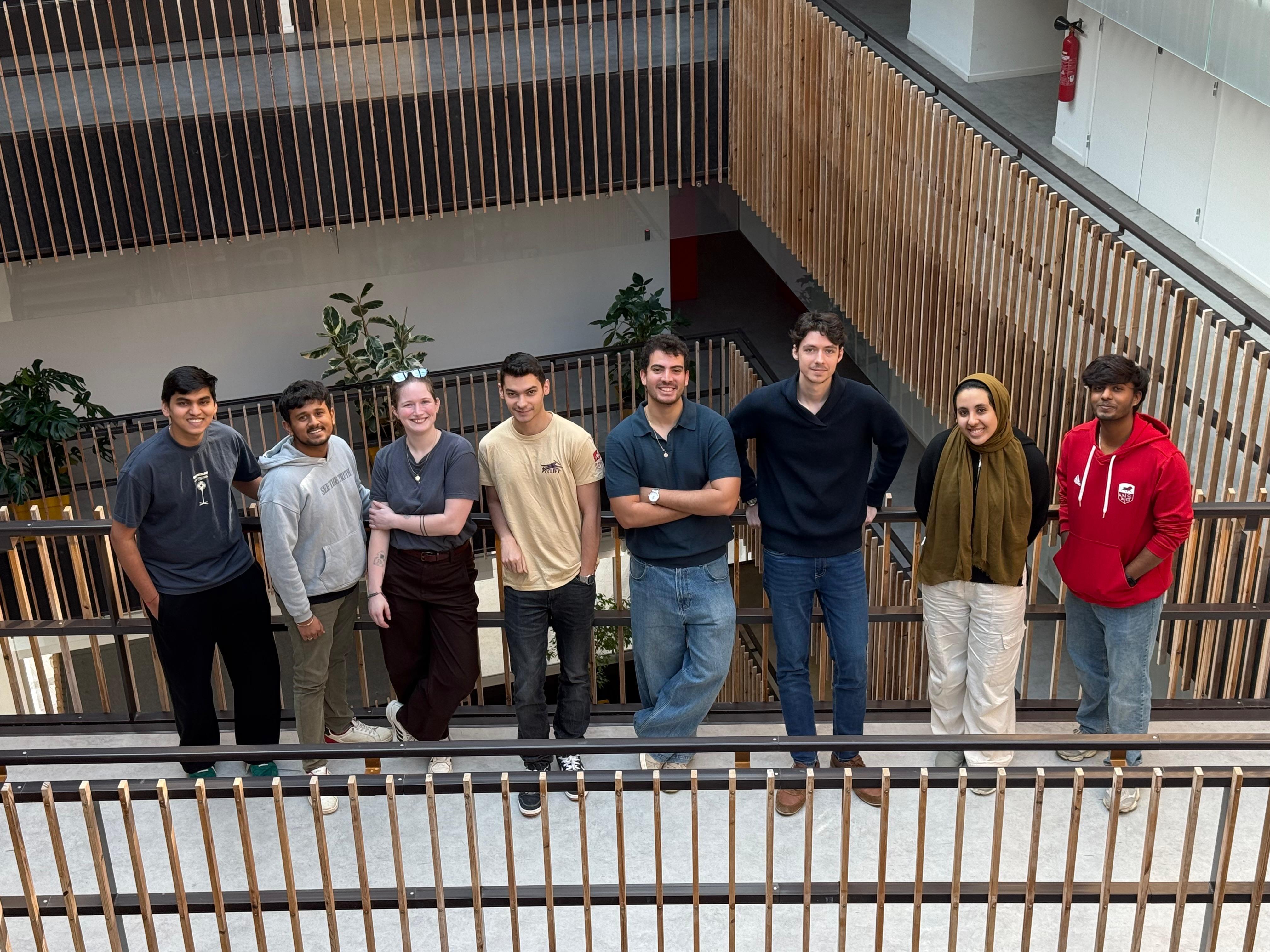
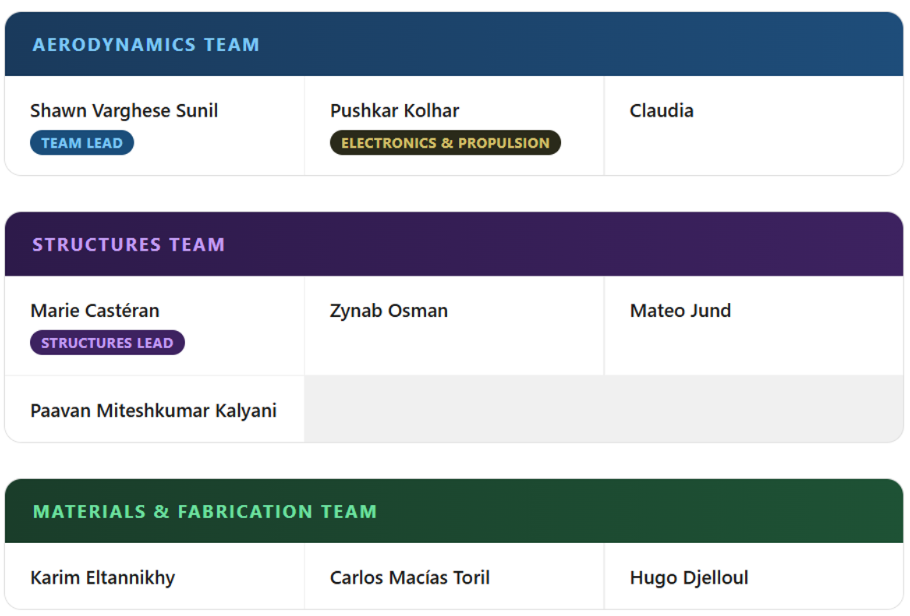
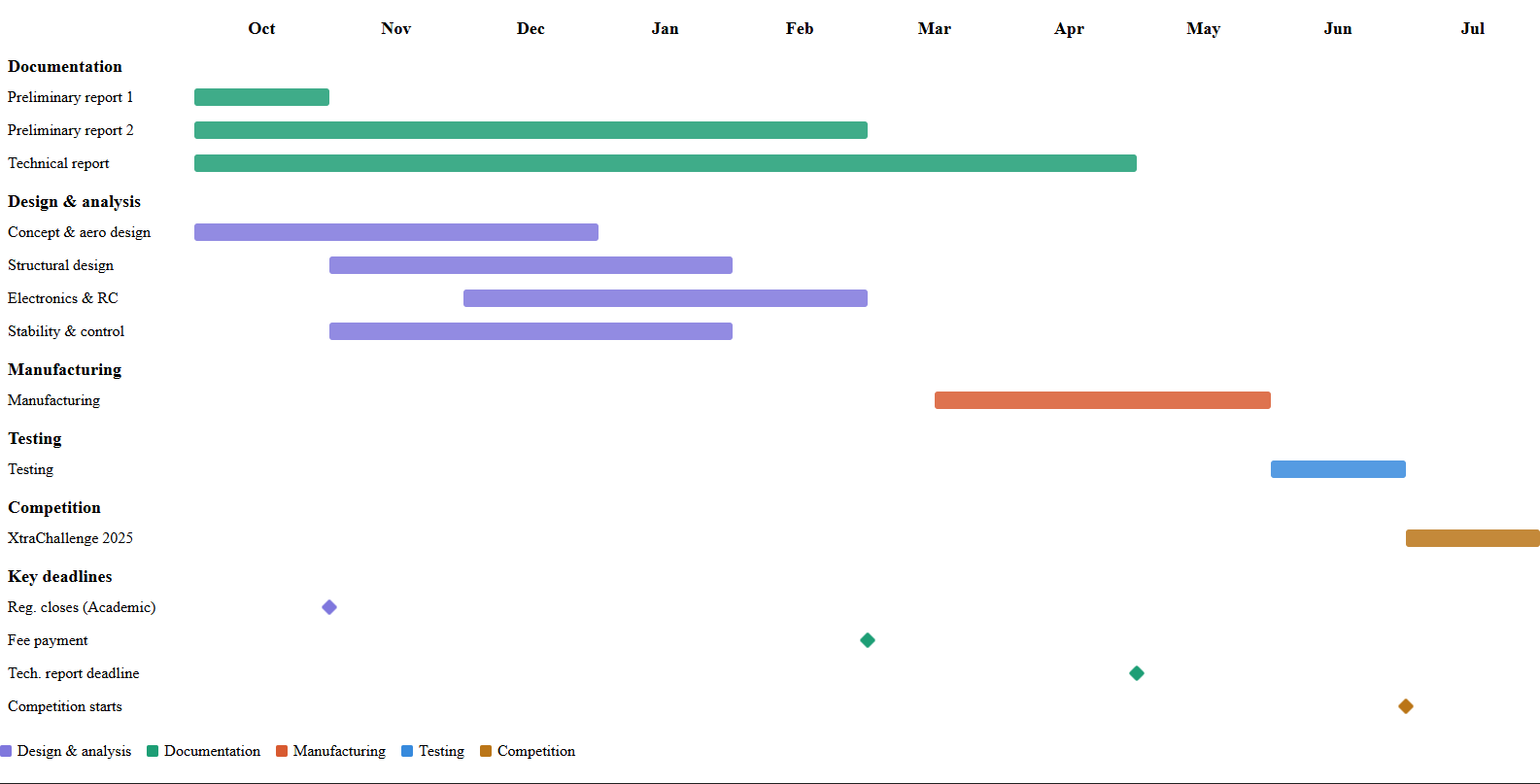
Aerodynamics Team
- Shawn Varghese Sunil Team Lead & Aerodynamics Master in Aerospace Engineering
- Pushkar Kolhar Electronics & Propulsion Lead Master in Aerospace Engineering
- Claudia Aerodynamics Analysis Master in Aerospace Engineering
Structures Team
- Marie Castéran Structures Lead Master in Aerospace Engineering
- Mateo Jund CAD Modeling & Technical Drawings Drawn Blueprint DWG-007
- Paavan Miteshkumar Kalyani CFD & Structural Analysis Master in Aerospace Engineering
- Zynab Osman Structural Design & Assembly Master in Aerospace Engineering
Materials & Fabrication
- Karim Eltannikhy Materials & Manufacturing Lead Epoxy Wet Layup & Ashby MCDM
- Carlos Macías Toril Composite Tooling & 3D Mold Printing Master in Aerospace Engineering
- Hugo Djelloul FabLab Laser Cutting & Assembly Ingénieur Généraliste · Centrale Lyon
Certified Competition Reports 2026
Direct access to the complete, certified engineering reports submitted to the international jury of XtraChallenge 2026 in València: XFLR5 low-Re polar calculations, static/dynamic stability root locus, propulsion bench test data with ESC thermal upgrade, Ashby multi-criteria decision method (MCDM), step-by-step composite fabrication photos, itemized budget compliance under €400, and Mateo Jund's official scale 1:12 engineering drawing (Dwg No. 007).
Coming Soon
Projet & Défi 2027 en cours de préparation
Rien n'est encore prévu pour la saison 2027. Les spécifications de l'appareil et les détails du projet seront dévoilés une fois le nouveau cahier des charges de la compétition publié.